Endometriosis: gene identified which could be potential treatment target – new study
Shutting down the activity of the NPSR1 gene in immune cells caused them to become less responsive and produce less of a protein that normally drives inflammation.
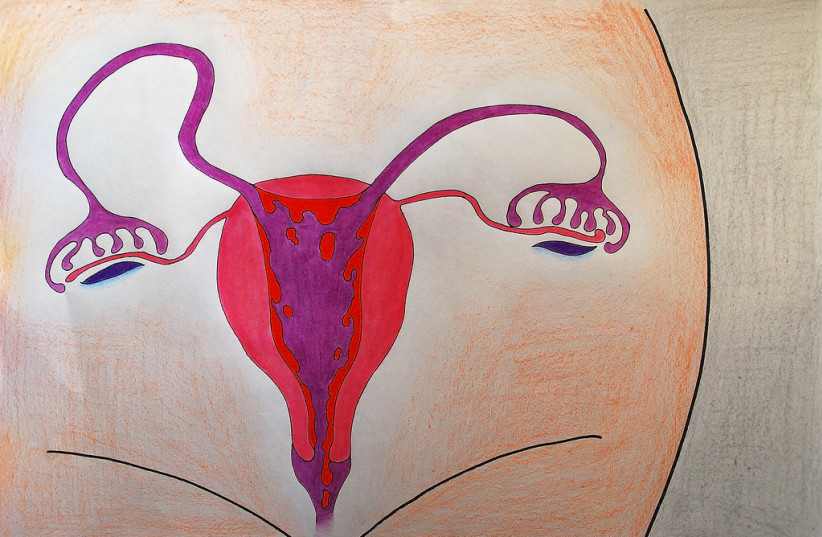
A colored drawing of female anatomy depicting a uterus, fallopian tubes and ovaries. Menstruation, monthly period (Illustrative) (photo credit: FLICKR)
Up to 10% of women experience endometriosis worldwide. The
condition is chronic, extremely painful, and can result in infertility.
Endometriosis happens when tissue similar to the lining of the uterus
(the endometrium) grows outside of the uterus, in the abdominal cavity
and sometimes on the ovaries and the fallopian tubes. These tissues
respond to the hormonal signals of the menstrual cycle just like the
endometrium does, which can cause severe pelvic or period pain.
How and why endometriosis
develops is unknown – and currently there’s no cure. While treatments
such as painkillers, surgery and even hormonal contraceptives are
available, they don’t always work, and many women find them to be
insufficient.
But a
team at Oxford University have been working on a collaborative study
that might have brought us one step closer towards finding a potential
new target for treatment.
The researchers have discovered that DNA variations in the gene
that produces the protein neuropeptide S receptor 1 (NPSR1) occur more
often in women with endometriosis than in women who don’t have the
condition. NPSR1 plays a role in the transmission of nerve signals and
in inflammation.
Oxford University
initially began conducting research on endometriosis after observing
that the condition can run in families – and that up to 50% of
endometriosis risk in women is due to genetics. But finding the genes
that cause the condition wasn’t a straightforward task. Endometriosis is
complex and influenced by many factors – including a person’s genetic
make-up, the environment, and the way these two factors interact.

A woman suffers stomach pains or cramps (Illustrative) (credit: FLICKR)
To
see what was different in the genetic make-up of endometriosis
patients, the team analyzed the genome – the complete set of genes any
person carries – of women with endometriosis and a family history of the
condition, and those without a known family history. In total, they
analyzed the genomes from 32 families with at least three women who had
endometriosis and 105 women without endometriosis, as well as consulted
another genetic dataset of more than 3,000 endometriosis cases and 2,300
controls.
The
familial analysis at first narrowed the cause down to an area on
chromosome seven, which contains around 100 genes. Only after further
and more detailed DNA sequencing did the researchers find that it was
the NPSR1 gene that carried significantly more harmful variants in women
with endometriosis than other genes within the chromosome seven area.
Women without endometriosis tended to have the normal NPSR1 gene more
often.
To further
confirm these findings, our collaborators at the University of
Wisconsin-Madison and Baylor College of Medicine then checked DNA
variations in a colony of rhesus macaques. These monkeys have periods
like humans do – and also get endometriosis. Sure enough, they found
that changes within the same region on the macaque equivalent of human
chromosome seven occurred more often in monkeys with endometriosis.
After
confirming this link, the next step of was to test whether shutting
down the activity of NPSR1 had any effect on inflammation associated
with endometriosis. The Oxford team collaborated with German pharma
group Bayer and found that shutting down the activity of NPSR1 in
immune cells caused them to become less responsive and produce less of a
protein that normally drives inflammation. The mice in turn showed
diminished inflammation and were in less pain than without the
treatment.
However,
the drug used in these experiments is what’s known as a “tool
compound” – meaning it’s only approved for use in cell and animal
experiments, but is not able to be used on humans. The next step of the
research will be finding a drug that can be used in humans to similarly
shut down NPSR1 activity, and see whether doing so also reduces symptoms
of endometriosis.
Interestingly,
NPSR1 also has a role in inflammation that occurs with other health
conditions, including asthma and inflammatory bowel disease. It’s also
found in certain regions of the brain, where it has effects on anxiety
and behaviour. This could mean that NPSR1 could play a role in the
perception of pain, and in the anxiety that goes along with
endometriosis.
Chronic
suffering and exposure to pain also changes the brain’s architecture –
meaning the wiring of the brain cells and nerves respond differently and
change over time. It might also be possible that the connection of
NPSR1 to endometriosis happens not just in inflammation and abdominal
pain, but also in the brain itself. This is another aspect of NSPR1 that
will need to be explored.
Regardless,
this research has shown that shutting down this receptor eases pain and
inflammation in mouse models of inflammation and endometriosis. This
opens up the future possibility for developing drugs against NPSR1 that
would ease symptoms of endometriosis without shutting down the menstrual
cycle, and potentially alleviate pain for millions of women.

Please Recommend this page and follow us at:

No comments:
Post a Comment
Stick to the subject, NO religion, or Party politics