Friday, 31 July 2020

Your brain parasite isn't making you sick—here's why

JULY 30, 2020, by University of Virginia
https://medicalxpress.com/news/2020-07-brain-parasite-isnt-sickhere.html


Tajie Harris, PhD, is part of UVA's Department of Neuroscience, the interim director of the Center for Brain Immunology and Glia (BIG), and a member of UVA's Carter Immunology Center.
 Credit: Dan Addison | UVA Communications


More than 30 million Americans are infected with a brain parasite spread by cats and contaminated meat, but most will never show symptoms. A new discovery from the University of Virginia School of Medicine explains why, and that finding could have important implications for brain infections, neurodegenerative diseases and autoimmune disorders.

The UVA researchers found that the parasite, Toxoplasma gondii, is kept in check by brain defenders called microglia. These microglia release a unique immune molecule, IL-1α, that recruits immune cells from the blood to control the parasite in the brain, the scientists discovered. This process works so well that very few people develop symptomatic toxoplasmosis, the disease the parasite causes.

Understanding the role of microglia is essential because they are normally the only immune cells inside the brain. The new finding reveals how they recruit help when needed, and that discovery could apply to any brain condition with an immunological component—including brain injury, neurodegenerative disease, stroke, multiple sclerosis and more.

"Microglia must die to save the brain from this infection," said researcher Tajie Harris, Ph.D., of UVA's Department of Neuroscience and the interim director of the Center for Brain Immunology and Glia (BIG). "Otherwise the IL-1α remains stuck inside the microglia and wouldn't alert the immune system that something is wrong."

The Brain and the Immune System

UVA's Department of Neuroscience and BIG center have in recent years completely rewritten our understanding of the brain's relationship with the body's immune system. For decades, textbooks taught that the brain was disconnected from the immune system. UVA research, however, showed that was not the case, to the shock of the scientific community. Many researchers are now exploring the implications of that major discovery.

One area of focus is microglia and their role in defending the brain. This has been a difficult question to answer because microglia are closely related to other immune cells elsewhere in the body. Until recently, laboratory tools made to target microglia have also targeted these other cells, making it hard to distinguish between the two.

UVA researcher Samantha J. Batista, a graduate student in Harris' lab, used an elegant approach that leveraged the long-lived nature of microglia to understand their role in brain infection. She and her colleagues found that infection caused microglia to die in an inflammatory fashion—a way that the closely related immune cells do not.

The microglia burst, the researchers determined, to recruit immune cells called macrophages to control the Toxoplasma gondii infection. This finding helps explain why most people have no trouble controlling the parasite, while some—especially people who are immunocompromised—can become very sick.

"Understanding pathways like this could be beneficial for other diseases involving neuroinflammation," Batista said. "We can ask whether promoting this pathway is helpful in situations where you need more of an immune presence in the brain, such as infections or cancers, and also whether inhibiting this molecule could be helpful in diseases driven by too much neuroinflammation, like multiple sclerosis. Targeting one specific pathway like this one could have less off-target effects than targeting inflammation more broadly."
In the future, Harris, Batista and their collaborators are interested in understanding how microglia detect the parasites in the brain. Microglia could recognize the parasite's presence directly, or they could recognize damage to brain tissue, a phenomenon that occurs in many diseases.

"The immune system must enter the brain to fight dangerous infections," said Harris, who is part of UVA's Carter Immunology Center. "We now understand how microglia sound the alarm to protect the brain. We suspect that similar signals are missed or misinterpreted in Alzheimer's disease, opening up an exciting new research avenue in the lab."

Recommend this post and follow The Life of Earth

Thursday, 30 July 2020

Bacteria in the gut have a direct line to the brain

JULY 29, 2020, by Katherine Fenz, Rockefeller University
https://medicalxpress.com/news/2020-07-bacteria-gut-line-brain.html

Three-dimensional view of mouse intestine shows sensory neurons in areas exposed to high-levels of microbial compounds. 
Credit: Rockefeller University


With its 100 million neurons, the gut has earned a reputation as the body's "second brain"—corresponding with the real brain to manage things like intestinal muscle activity and enzyme secretions. A growing community of scientists are now seeking to understand how gut neurons interact with their brain counterparts, and how failures in this process may lead to disease.

Now, new research shows that gut bacteria play a direct role in these neuronal communications, determining the pace of intestinal motility. The research, conducted in mice and published in Nature, suggests a remarkable degree of communication between our nervous system and the microbiota. It may also have implications for treating gastrointestinal conditions.

"We describe how microbes can regulate a neuronal circuit that starts in the gut, goes to the brain, and comes back to the gut," says Rockefeller's Daniel Mucida, associate professor and head of the Laboratory of Mucosal Immunology. "Some of the neurons within this circuit are associated with irritable bowel syndrome, so it is possible that dysregulation of this circuit predisposes to IBS."

The work was led by Paul A. Muller, a former graduate student in the Mucida lab.

How microbes control motility

To understand how the central nervous system senses microbes within the intestines, Mucida and his colleagues analyzed gut-connected neurons in mice that lacked microbes entirely, so-called germ-free mice that are raised from birth in an isolated environment, and given only food and water that has been thoroughly sterilized. They found that some gut-connected neurons are more active in the germ-free mice than in controls and express high levels of a gene called cFos, which is a marker for neuronal activity.

This increase in neuronal activity, in turn, causes food to move more slowly than usual through the digestive tract of the mice. When the researchers treated the germ-free mice with a drug that silences these gut neurons, they saw intestinal motility speed up.

It's unclear how the neurons sense the presence of gut microbes, but Mucida and his colleagues found hints that the key may be a set of compounds known as short-chain fatty acids, which are made by gut bacteria. They found that lower levels of these fatty acids within the guts of mice were associated with greater activity of the gut-connected neurons. And when they boosted the animal's gut levels of these compounds, the activity of their gut neurons decreased. Other microbial compounds and gut hormones that change with the microbiota were also found to regulate neuronal activity, suggesting additional players in this circuit.

Neurons in control

Further experiments revealed a conundrum, however. The scientists saw that the particular type of gut-connected neurons activated by the absence of microbes did not extend to the exposed surface of the intestines, suggesting that they cannot sense the fatty acid levels directly.

So Mucida and his colleagues decided to trace the circuit backwards and found a set of brainstem neurons that show increased activity in the germ-free mice. When the researchers manipulated control mice to specifically activate these same neurons, they saw an increase in the activity of the gut neurons and a decrease in intestinal motility.

The researchers continued to work backwards, next focusing their attention on the sensory neurons that send signals from the intestines to the brainstem. Their experiments revealed these sensory neurons extended to the interface of areas of the intestine that are exposed to high-levels of microbial compounds, including fatty acids. They turned off these neurons, to mimic what happens in germ-free mice that lack the fatty acids, or associated gut signals, and observed activated neurons in the brainstem, as well as activation of the gut neurons that control intestinal motility.

"We traced the whole loop and saw that neurons outside the intestines can be controlled by what happens inside the intestines," Mucida says. "It is plausible that the circuit identified here could be involved in additional gut-brain bidirectional interactions, which could influence several intestinal as well as neurological diseases, including IBS and even behavioral abnormalities."

Recommend this post and follow The birth of Modern Man

Could prior exposure to common cold viruses affect the severity of SARS-CoV-2 symptoms?

JULY 29, 2020, by Charité - Universitätsmedizin Berlin
https://medicalxpress.com/news/2020-07-prior-exposure-common-cold-viruses.html


A colorized scanning electron micrograph of the SARS-CoV-2 virus. Credit: NIAID


Universitätsmedizin Berlin and the Max Planck Institute for Molecular Genetics (MPIMG) show that some healthy individuals possess immune cells capable of recognizing the novel coronavirus, SARS-CoV-2. The reason for this might be found in prior infections with 'common cold' coronaviruses. Whether or not this cross-reactivity has a protective effect on the clinical course in individuals infected with SARS-CoV-2 will now be addressed by the 'Charité Corona Cross' study.

Why is it that some people develop severe symptoms following infection with the novel coronavirus, while others hardly notice the infection? The answer to this question is multilayered and is the subject of intensive research. One potentially crucial factor has now been identified by a team of researchers from Charité and the MPIMG: prior exposure to harmless 'common cold' coronaviruses. This insight is based on research involving T-helper cells, a type of specialized white blood cell which is essential to the regulation of our immune response. The researchers found that one in three people with no prior exposure to SARS-CoV-2 nonetheless have T-helper cells capable of recognizing the virus. The likely reason for this is that SARS-CoV-2 shares certain structural similarities with coronaviruses which are responsible for the common cold.

For their study, the researchers isolated immune cells from the blood of 18 COVID-19 patients receiving treatment at Charité and confirmed PCR positive for SARS-CoV-2. They also isolated immune cells from the blood of 68 healthy individuals who had never been exposed to the novel coronavirus. The researchers then stimulated these immune cells using small, synthetic fragments of SARS-CoV-2 'spike proteins', the characteristic, crown-like protrusions on the outer surface of coronaviruses which enable the virus to enter human cells. The researchers subsequently tested whether the T-helper cells would be activated by contact with these protein fragments. They found that this was the case in 15 out of 18 patients with COVID-19 (85%). "This was exactly what we had expected. The immune system in these patients was in the process of fighting this novel virus, and therefore showed the same reaction in vitro," explains one of the study's three lead authors, Dr. Claudia Giesecke-Thiel, head of the Flow Cytometry Facility at the MPIMG. She adds: "The fact that not all patients with COVID-19 showed this T-helper cell response to viral fragments is probably due to fact that T cells cannot be activated outside the human body during an acute or particularly severe phase of an illness."

The team were, however, surprised to find memory T-helper cells capable of recognizing fragments of SARS-CoV-2 in the blood of healthy individuals. They were found in a total of 24 out of 68 healthy individuals tested (35%). In fact, the researchers noticed that the immune cells of COVID-19 patients reacted to different fragments of the viral envelope than the immune cells of healthy individuals. While the T-helper cells of patients recognized the spike protein in its full length, the T-helper cells isolated from healthy individuals were primarily activated by sections of the spike protein which showed similarity to corresponding sections found in the spike proteins of harmless 'common cold' coronaviruses. "This suggests that the T-helper cells of healthy individuals react to SARS-CoV-2 because of previous exposure to the endemic 'common cold' coronaviruses," says Dr. Giesecke-Thiel. She goes on to explain: "One of the characteristics of T-helper cells is that they are not only activated by a pathogen with an 'exact fit', but also by pathogens with 'sufficient similarity'." Notably, the researchers were able to show that the T-helper cells isolated from healthy participants who reacted to SARS-CoV-2 were also activated by various 'common cold' coronaviruses—displaying what is known as 'cross-reactivity'.

What effects this cross-reactivity might have on a previously healthy person infected with SARS-CoV-2 was not addressed in the current study. "Generally speaking, it is possible that cross-reactive T-helper cells have a protective effect, for instance by helping the immune system speed up its production of antibodies against the novel virus," explains co-lead author Prof. Dr. Leif Erik Sander of Charité's Medical Department, Division of Infectious Diseases and Respiratory Medicine. He adds: "In this case, a recent bout of the common cold would probably result in less severe COVID-19 symptoms. However, it is also possible that cross-reactive immunity could lead to a misdirected immune response and potentially negative effects on the clinical course of COVID-19. We know this can occur with dengue fever, for instance."

Prospective studies will be needed in order to conclusively determine whether previous 'common cold' coronavirus infections confer protection against subsequent infection with SARS-CoV-2—and whether this might explain the high variability in clinical manifestations. One such study, which will be led by Charité and conducted in collaboration with Technische Universität Berlin and the MPIMG, has just been launched. Funded by the Federal Ministry of Health (BMG) and the Federal Institute for Drugs and Medical Devices (BfArM), the 'Charité Corona Cross Study' will investigate the impact of cross-reactive T-helper cells on the course of COVID-19.

In Germany, coronaviruses are responsible for up to 30 percent of all seasonal colds, says Prof. Dr. Andreas Thiel, a Charité researcher based at both the Si-M ('Der Simulierte Mensch—literally 'The Simulated Human', a joint research space of Charité and Technische Universität Berlin) and the BIH Center for Regenerative Therapies (BCRT). "Current estimates suggest that the average adult will contract an infection caused by one of the four endemic coronaviruses approximately every two to three years," explains Prof. Thiel, who is the article's third co-lead author and responsible for coordinating the Charité Corona Cross Study. He adds: "If we assume that these cold viruses are capable of conferring a certain level of immunity against SARS-CoV-2, this would mean that people who have had frequent exposure to such infections in the past, and who test positive for cross-reactive T-helper cells, should have better protection. This group of people will therefore be a particular focus of the 'Charité Corona Cross Study'." The researchers will simultaneously follow COVID-19 risk populations over several months. Ultimately, the study aims to help predict the clinical course of COVID-19, both in people with and without previous SARS-CoV-2 infections. "This is of paramount importance, both in terms of people's day-to-day lives and the treatment of patients," explains Prof. Thiel.

The study includes a comprehensive immunological investigation of child daycare staff, pediatric practice staff and care home residents, which will last well into next year. Swabs collected from participants will be tested for SARS-CoV-2 using PCR-based testing. Additional tests will include tests for antibodies against the virus and for T cell reactivity. Should study participants subsequently contract SARS-CoV-2, the researchers will be able to establish links between the course of the disease and individual patients' immunological parameters.

The researchers also plan to collect blood samples from a minimum of 1,000 recovered COVID-19 patients. These will then be tested for a range of immunological factors in order to study how they correlate with symptoms. The team hope to be able to identify other potential parameters which influence COVID-19 severity and clinical course. The researchers are currently looking for individuals who were confirmed cases of COVID-19 and subsequently recovered from the illness. They would also like to hear from individuals who, at some point over the past few years, developed infections subsequently confirmed as caused by 'common cold' coronaviruses like 229E, C43, NL63 or HKU1.

Recommend this post and follow The Life of Earth

Alaskan seismometers record the northern lights

JULY 29, 2020, by Seismological Society of America
https://phys.org/news/2020-07-alaskan-seismometers-northern.html

Aurora near Poker Flats, Alaska. Credit: Aaron Lojewski, Fairbanks Aurora Tours

Aaron Lojewski, who leads aurora sightseeing tours in Alaska, was lucky enough to photograph a "eruption" of brilliant pink light in the night skies one night in February.

The same perturbations of the Earth's magnetic field that lit up the sky for Lojewski's camera were also captured by seismometers on the ground, a team of researchers reports in the journal Seismological Research Letters.

By comparing data collected by all-sky cameras, magnetometers, and seismometers during three aurora events in 2019, University of Alaska Fairbanks seismologist Carl Tape and colleagues show that it's possible to match the striking display of lights with seismic signals, to observe the same phenomenon in different ways.

Researchers have known for a while that seismometers are sensitive to magnetic fluctuations—and have worked hard to find ways to shield their instruments against magnetic influence or to remove these unwanted signals from their seismic data. But the aurora study offers an example of how seismometers could be paired with other instruments to study these fluctuations.

"It can be hard to be definitive that these seismometer recordings are originating from the same influence as what's going on 120 kilometers up in the sky," Tape said. "It helps to have a simultaneous view of the sky, to given you more confidence about what you're seeing from the signals at ground level."

The aurora borealis, or northern lights, occurs when solar winds—plasma ejected from the Sun's surface—meet the protective magnetic field that surrounds the Earth. The collision of particles produces colorful lights in the sky and creates fluctuations in the magnetic field that are sometimes called solar or space "storms." Magnetometers deployed on the Earth's surface are the primary instrument used to detect these fluctuations, which can significantly impact electrical grids, GPS systems and other crucial infrastructure. The aurora is commonly visible in wintertime in high-latitude regions such as Alaska.

The seismometers in the study are part of the USArray Transportable Array, a network of temporary seismometers placed across North America as part of the EarthScope project. The array in Alaska and western Canada was completed in the fall of 2017. The aurora paper is one of several included in an upcoming SRL focus section about EarthScope in Alaska and Canada.

These temporary seismic stations are not shielded from magnetic fields, unlike more permanent stations that are often cloaked in mu-metal, a nickel-iron alloy that directs magnetic fields around the instrument's sensors. As a result, "I was blown away by how well you can record magnetic storms across the array," said U.S. Geological Survey seismologist Adam Ringler, a co-author on the SRL paper.

Last month, Ringler and his colleagues published a paper demonstrating how the array's 200-plus seismometers in Alaska can be used to record space weather, potentially augmenting the 13 magnetometers in operation in the state.

Along with the all-sky camera data, seismic array data can help make sense of the strong variations in the magnetic field that occur in a magnetic east-west direction, adding a second dimension to typical north-south directional studies of the aurora and other magnetic storms, Tape and colleagues suggest.

The researchers noted in their paper that the link between the aurora borealis and magnetic perturbations was first discovered in Sweden in 1741, and that a seismometer in Germany detected an atmosphere-generated magnetic event for the first time during a strong solar storm in 1994.

"People have been making these connections for 250 years," Tape said. "This shows that we can still make discoveries, in this case with seismometers, to understand the aurora."

Recommend this post and follow The Life of Earth

Wednesday, 29 July 2020

Metal-breathing bacteria could transform electronics, biosensors, and more

JULY 28, 2020, by Torie Wells, Rensselaer Polytechnic Institute
https://phys.org/news/2020-07-metal-breathing-bacteria-electronics-biosensors.html

Credit: Rensselaer Polytechnic Institute

When the Shewanella oneidensis bacterium "breathes" in certain metal and sulfur compounds anaerobically, the way an aerobic organism would process oxygen, it produces materials that could be used to enhance electronics, electrochemical energy storage, and drug-delivery devices.

The ability of this bacterium to produce molybdenum disulfide—a material that is able to transfer electrons easily, like graphene—is the focus of research published in Biointerphases by a team of engineers from Rensselaer Polytechnic Institute.

"This has some serious potential if we can understand this process and control aspects of how the bacteria are making these and other materials," said Shayla Sawyer, an associate professor of electrical, computer, and systems engineering at Rensselaer.

The research was led by James Rees, who is currently a postdoctoral research associate under the Sawyer group in close partnership and with the support of the Jefferson Project at Lake George—a collaboration between Rensselaer, IBM Research, and The FUND for Lake George that is pioneering a new model for environmental monitoring and prediction. This research is an important step toward developing a new generation of nutrient sensors that can be deployed on lakes and other water bodies.

"We find bacteria that are adapted to specific geochemical or biochemical environments can create, in some cases, very interesting and novel materials," Rees said. "We are trying to bring that into the electrical engineering world."

Rees conducted this pioneering work as a graduate student, co-advised by Sawyer and Yuri Gorby, the third author on this paper. Compared with other anaerobic bacteria, one thing that makes Shewanella oneidensis particularly unusual and interesting is that it produces nanowires capable of transferring electrons.

"That lends itself to connecting to electronic devices that have already been made," Sawyer said. "So, it's the interface between the living world and the manmade world that is fascinating."

Sawyer and Rees also found that, because their electronic signatures can be mapped and monitored, bacterial biofilms could also act as an effective nutrient sensor that could provide Jefferson Project researchers with key information about the health of an aquatic ecosystem like Lake George.

"This groundbreaking work using bacterial biofilms represents the potential for an exciting new generation of 'living sensors,' which would completely transform our ability to detect excess nutrients in water bodies in real-time. This is critical to understanding and mitigating harmful algal blooms and other important water quality issues around the world," said Rick Relyea, director of the Jefferson Project.

Sawyer and Rees plan to continue exploring how to optimally develop this bacterium to harness its wide-ranging potential applications.

"We sometimes get the question with the research: Why bacteria? Or, why bring microbiology into materials science?" Rees said. "Biology has had such a long run of inventing materials through trial and error. The composites and novel structures invented by human scientists are almost a drop in the bucket compared to what biology has been able to do."  


Recommend this post and follow The Life of Earth

Deep sea microbes dormant for 100 million years are hungry and ready to multiply

JULY 28, 2020, by University of Rhode Island
https://phys.org/news/2020-07-deep-sea-microbes-dormant-million.html

Magnified image showing microbes revived from 101.5 million-year-old sediment. 
Credit: JAMSTEC

For decades, scientists have gathered ancient sediment samples from below the seafloor to better understand past climates, plate tectonics and the deep marine ecosystem. In a new study published in Nature Communications, researchers reveal that given the right food in the right laboratory conditions, microbes collected from sediment as old as 100 million years can revive and multiply, even after laying dormant since large dinosaurs prowled the planet.

The research team behind the new study, from the Japan Agency for Marine-Earth Science and Technology (JAMSTEC), the URI Graduate School of Oceanography, the National Institute of Advanced Industrial Science and Technology, the Kochi University and Marine Works Japan, gathered the ancient sediment samples ten years ago during an expedition to the South Pacific Gyre, the part of the ocean with the lowest productivity and fewest nutrients available to fuel the marine food web.

"Our main question was whether life could exist in such a nutrient-limited environment or if this was a lifeless zone," said the paper's lead author Yuki Morono, senior scientist at JAMSTEC. "And we wanted to know how long the microbes could sustain their life in a near-absence of food."

On the seafloor, there are layers of sediment consisting of marine snow (organic debris continually sourced from the sea surface), dust, and particles carried by the wind and ocean currents. Small life forms such as microbes become trapped in this sediment.

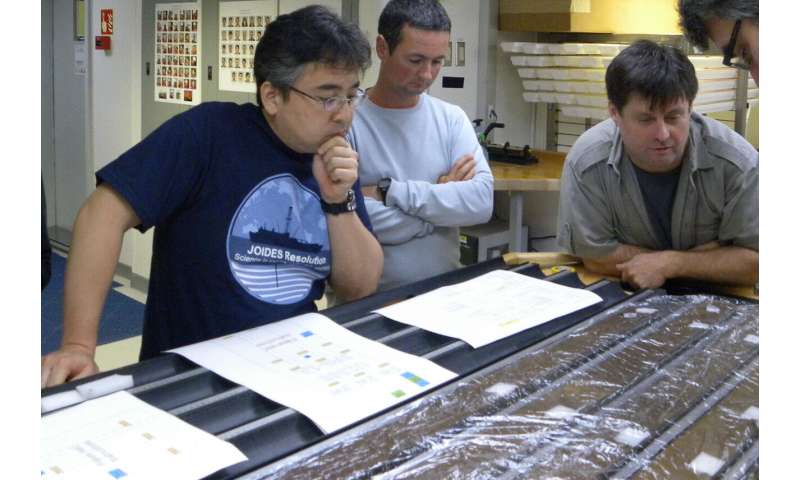
Aboard the research drillship JOIDES Resolution, the team drilled numerous sediment cores 100 meters below the seafloor and nearly 6,000 meters below the ocean's surface. The scientists found that oxygen was present in all of the cores, suggesting that if sediment accumulates slowly on the seafloor at a rate of no more than a meter or two every million years, oxygen will penetrate all the way from the seafloor to the basement. Such conditions make it possible for aerobic microorganisms—those that require oxygen to live—to survive for geological time scales of millions of years.

Yuki Morono (left) and Steven D'Hondt (far right) aboard the research drillship JOIDES Resolution with sediment cores gathered from the South Pacific Gyre. 
Credit: IODP JRSO

With fine-tuned laboratory procedures, the scientists, led by Morono, incubated the samples to coax their microbes to grow. The results demonstrated that rather than being fossilized remains of life, the microbes in the sediment had survived, and were capable of growing and dividing.

"We knew that there was life in deep sediment near the continents where there's a lot of buried organic matter," said URI Graduate School of Oceanography professor and co-author of the study Steven D'Hondt. "But what we found was that life extends in the deep ocean from the seafloor all the way to the underlying rocky basement."

Morono was initially taken aback by the results. "At first I was skeptical, but we found that up to 99.1% of the microbes in sediment deposited 101.5 million years ago were still alive and were ready to eat," he said.

With the newly developed ability to grow, manipulate and characterize ancient microorganisms, the research team is looking forward to applying a similar approach to other questions about the geological past. According to Morono, life for microbes in the subseafloor is very slow compared to life above it, and so the evolutionary speed of these microbes will be slower. "We want to understand how or if these ancient microbes evolved," he said. "This study shows that the subseafloor is an excellent location to explore the limits of life on Earth."

Before looking ahead to future research, D'Hondt took time to reflect on Morono's achievement. "What's most exciting about this study is that it shows that there are no limits to life in the old sediment of the world's ocean," said D'Hondt. "In the oldest sediment we've drilled, with the least amount of food, there are still living organisms, and they can wake up, grow and multiply."


Recommend this post and follow 
The Life of Earth       

Tuesday, 28 July 2020

Researchers quantify, characterize and identify functions of collagen, its subtypes

JULY 27, 2020, by Brian Bell, University of California, Irvine
https://phys.org/news/2020-07-quantify-characterize-functions-collagen-subtypes.html

Credit: University of California, Irvine

Found in cartilage, bones, blood vessels, skin, and other connective tissues, collagens are the most abundant proteins by weight in the human body. In an article published recently in Nature Reviews Materials, UCI biomedical engineering researchers provide an exhaustive description of the superfamily of this biomaterial, which includes 28 subtypes.

"Collagen—which has known connections to maladies including cancer, arthritis and more than 40 hereditary diseases—has been the focus of intensive biomedical research for centuries," said co-author Kyriacos Athanasiou, Distinguished Professor of biomedical engineering and Henry Samueli Chair in Engineering at UCI. "Knowledge about the major subgroups of collagens is well-established, but there is still much we can learn about minor collagens and their cross-links. Indeed, minor collagens play major roles."

Athanasiou's lab group relies on the latest tools in analytical chemistry and mass spectrometry to fully characterize collagenous tissues—with the goal of engineering "neotissues" that can replace those degraded by disease or injury. In the article, the UCI authors recommend new approaches to studying these materials, such as high-throughput experimentation and machine learning.

"Accurate collagen analysis is important to researchers in a variety of fields, including tissue characterization and engineering, drug development and delivery, and biomechanics," said lead author Benjamin Bielajew, a UCI doctoral student in biomedical engineering. "In this article, we call on biomedical engineers to use modern methods with enhanced sensitivity, specificity and cost-effectiveness to engineer robust tissues. For example, arthritis affects over 30 million American adults, and proper assessment of collagen is a critical step in engineering cartilages to address this massive problem."

Jerry Hu, a UCI program manager in biomedical engineering, also participated in this project, which was funded by three grants from the National Institutes of Health.


Recommend this post and follow The Life of Earth

Lithium in drinking water linked with lower suicide rates

JULY 27, 2020, by University of Sussex
https://medicalxpress.com/news/2020-07-lithium-linked-suicide.html


Credit: CC0 Public Domain

Naturally occurring lithium in public drinking water may have an anti-suicidal effect—according to a new study from Brighton and Sussex Medical School (BSMS) and the Institute of Psychiatry, Psychology & Neuroscience at King's College London.

Published in the British Journal of Psychiatry, the study collated research from around the world and found that geographical areas with relatively high levels or concentration of lithium in public drinking water had correspondingly lower suicide rates.

Professor Anjum Memon, Chair in Epidemiology and Public Health Medicine at BSMS and lead author of the study, said: "It is promising that higher levels of trace lithium in drinking water may exert an anti-suicidal effect and have the potential to improve community mental health. The prevalence of mental health conditions and national suicide rates are increasing in many countries. Worldwide, over 800,000 people die by suicide every year, and suicide is the leading cause of death among persons aged 15-24 years." 

"In these unprecedented times of COVID-19 pandemic and the consequent increase in the incidence of mental health conditions, accessing ways to improve community mental health and reduce the incidence of anxiety, depression and suicide is ever more important."  

Lithium, sometimes referred to as the 'Magic Ion', is widely and effectively used as a medication for the treatment and prevention of manic and depressive episodes, stabilising mood and reducing the risk of suicide in people with mood disorders. Its anti-aggressive properties can help reduce impulsivity, aggression, violent criminal behaviour and chronic substance abuse.

Lithium is a naturally occurring element and is found in variable amounts in vegetables, grains, spices and drinking water. It is present in trace amounts in virtually all rocks, and is mobilised by weathering into soils, ground and standing water, and thus into the public water supply.

The health benefits and curative powers of naturally occurring lithium in water have been known for centuries. The Lithia Springs, an ancient Native American sacred medicinal spring, with its natural lithium-enriched water, is renowned for its health-giving properties. In fact, the popular soft drink 7-Up contained lithium when it was created in 1929.
 
Recent studies have also linked lithium to reduced incidence of Alzheimer's disease and other dementias. This raises the potential for its preventative use to combat the risk of dementia.

Professor Allan Young, Chair of Mood Disorders at King's College London, said: "This synthesis and analysis of all available evidence confirms previous findings of some individual studies and shows a significant relationship between higher lithium levels in drinking water and lower suicide rates in the community. The levels of lithium in drinking water are far lower than those recommended when lithium is used as medicine although the duration of exposure may be far longer, potentially starting at conception. These findings are also consistent with the finding in clinical trials that lithium reduces suicide and related behaviours in people with a mood disorder."

Professor Memon added: "Next steps might include testing this hypothesis by randomised community trials of lithium supplementation of the water supply, particularly in communities (or settings) with demonstrated high prevalence of mental health conditions, violent criminal behaviour, chronic substance abuse and risk of suicide. This may provide further evidence to support the hypothesis that lithium could be used at the community level to reduce or combat the risk of these conditions."

Professor Carmine Pariante from the Royal College of Psychiatrists, commented: "This study shows that the boundaries between medication and nutritional interventions are not as rigid as we used to think, opening up the possibility of new treatments that span both domains. More knowledge of the beneficial properties of lithium and its role in regulating brain function can lead to a deeper understanding of mental illness and improve the wellbeing of patients with depression and other mental health problems." 

The study involved systematic review and meta-analysis of all previous studies on the subject—conducted in Austria, Greece, Italy, Lithuania, UK, Japan and USA—which correlated naturally occurring lithium levels in drinking water samples and suicide rates in 1,286 regions/counties/cities in these countries.

Recommend this post and follow The birth of modern Man

Medieval medicine remedy could provide new treatment for modern day infections

JULY 28, 2020, by University of Warwick
https://phys.org/news/2020-07-medieval-medicine-remedy-treatment-modern.html

The Balds Eyesalve mixture in the lab. Credit: University of Warwick

Antibiotic resistance is an increasing battle for scientists to overcome, as more antimicrobials are urgently needed to treat biofilm-associated infections. However scientists from the School of Life Sciences at the University of Warwick say research into natural antimicrobials could provide candidates to fill the antibiotic discovery gap.

Bacteria can live in two ways, as individual planktonic cells or as a multicellular biofilm. Biofilm helps protect bacteria from antibiotics, making them much harder to treat, one such biofilm that is particularly hard to treat is those that infect diabetic foot ulcers.

Researchers at the University of Warwick, Dr. Freya Harrison, Jessica Furner-Pardoe, and Dr. Blessing Anonye, have looked at natural remedies for the gap in the antibiotic market, and in the paper, 'Anti-biofilm efficacy of a medieval treatment for bacterial infection requires the combination of multiple ingredients' published in the journal Scientific Reports today the 28 July, researchers say medieval methods using natural antimicrobials from every day ingredients could help find new answers.

The Ancientbiotics research team was established in 2015 and is an interdisciplinary group of researchers including microbiologists, chemists, pharmacists, data analysts and medievalists at Warwick, Nottingham and in the United States.

Building on previous research done by the University of Nottingham on using medieval remedies to treat MRSA, the researchers from the School of Life Sciences at University of Warwick reconstructed a 1,000-year-old medieval remedy containing onion, garlic, wine, and bile salts, which is known as 'Bald's eyesalve', and showed it to have promising antibacterial activity. The team also showed that the mixture caused low levels of damage to human cells.

They found the Bald's eyesalve remedy was effective against a range of Gram-negative and Gram-positive wound pathogens in planktonic culture. This activity is maintained against the following pathogens grown as biofilms:

The actual eyesalve remedy text. 
Credit: The British Library Board (Royal 12 D xvii)

1.Acinetobacter baumanii—commonly associated with infected wounds in combat troops returning from conflict zones.

2. Stenotrophomonas maltophilia—commonly associated with respiratory infections in humans

3. Staphylococcus aureus—a common cause of skin infections including abscesses, respiratory infections such as sinusitis, and food poisoning.

4. Staphylococcus epidermidis—a common cause of infections involving indwelling foreign devices such as a catheter, surgical wound infections, and bacteremia in immunocompromised patients.

5. Streptococcus pyogenes—causes numerous infections in humans including pharyngitis, tonsillitis, scarlet fever, cellulitis, rheumatic fever and post-streptococcal glomerulonephritis.

All of these bacteria can be found in the biofilms that infect diabetic foot ulcers and which can be resistant to antibiotic treatment. These debilitating infections can lead to amputation to avoid the risk of the bacteria spreading to the blood to cause lethal bacteremia.

The leechbook. 
Credit: The British Library Board (Royal 12 D xvii)

The Bald's eyesalve mixtures use of garlic, which contains allicin, can explain activity against planktonic cultures, however garlic alone has no activity against biofilms, and therefore the anti-biofilm activity of Bald's eyesalve cannot be attributed to a single ingredient and requires the combination of all ingredients to achieve full activity.

Dr. Freya Harrison, from the School of Life Sciences at the University of Warwick comments:
"We have shown that a medieval remedy made from onion, garlic, wine, and bile can kill a range of problematic bacteria grown both planktonically and as biofilms. Because the mixture did not cause much damage to human cells in the lab, or to mice, we could potentially develop a safe and effective antibacterial treatment from the remedy.

"Most antibiotics that we use today are derived from natural compounds, but our work highlights the need to explore not only single compounds but mixtures of natural products for treating biofilm infections. We think that future discovery of antibiotics from natural products could be enhanced by studying combinations of ingredients, rather than single plants or compounds. In this first instance, we think this combination could suggest new treatments for infected wounds, such as diabetic foot and leg ulcers. "

Jessica Furner-Pardoe, from the Medical School at the University of Warwick comments:
"Our work demonstrates just how important it is to use realistic models in the lab when looking for new antibiotics from plants. Although a single component is enough to kill planktonic cultures, it fails against more realistic infection models, where the full remedy succeeds."

In previous research Christina Lee, from the School of English at the University of Nottingham, had examined the Bald's Leechbook, an Old English leatherbound volume in the British Library, to see if it really works as an antibacterial remedy. The Leechbook is widely thought of as one of the earliest known medical textbooks and contains Anglo-Saxon medical advice and recipes for medicines, salves and treatments. Christina adds:"Bald's eyesalve underlines the significance of medical treatment throughout the ages. It shows that people in Early Medieval England had at least some effective remedies. The collaboration which has informed this project shows the importance of the arts in interdisciplinary research."


Recommend this post and follow The birth of modern Man

Monday, 27 July 2020

Rely on gut feeling? New research identifies how second brain in gut communicates

JULY 24, 2020, by Flinders University
https://medicalxpress.com/news/2020-07-gut-brain.html

Credit: Pixabay/CC0 Public Domain

You're faced with a big decision so your second brain provides what's normally referred to as "gut instinct," but how did this sensation reach you before it was too late?

The enteric nervous system (ENS) is an extensive network of neurons and transmitters wrapped in and around the human gut with the prime function of managing digestion, but researchers at Flinders University are delving into the complexity of this brain like system to uncover it's secret capabilities.

In a new study published in the eNeuro journal, Professor Nick Spencer's laboratory has identified a particular type of neuron in the gut wall that communicates signals to other neurons outside the gut, near the spinal cord and up to the brain.

"There is significant interest in how the gut communicates with the brain as a major unresolved issue because of growing evidence that many diseases may first start in the gut and then travel to the brain, an example of which is Parkinson's Disease," says Professor Spencer.

"The new study has uncovered how viscerofugal neurons provide a pathway so our gut can 'sense' what is going on inside the gut wall, then relay this sensory information more dynamically than was previously assumed to other organs, like the spinal cord and brain which influence our decisions, mood and general wellbeing."

The results reveal why the ENS might play an increasingly important part on human health, and could shed light on potential new treatments for conditions like Parkinson's disease.

This study represents a big step towards understanding ENS functions and the complexity of the gut and brain connection through the neurons that allow communication in the body.

Professor Spencer says there is increasing interest in understanding how the nervous system in the gut (ENS) communicates with the brain, to give us all those sensations we know of.

"What is particularly exciting about the gut, is that it is unlike all other internal organs (e.g. heart, liver, bladder) because the gut has its own nervous system, which can function independently of the brain or spinal cord. Understanding how the gut communicates and controls other organs in the body can lead to important breakthroughs for disease treatment and this is an important step in the right direction."

Recommend this post and follow The birth of modern Man

Passion for purple revives ancient dye in Tunisia

JULY 26, 2020, by Kaouther Larbi
https://phys.org/news/2020-07-passion-purple-revives-ancient-dye.html

After years of trial and error - and after getting used to the foul stench - Mohamed Ghassen Nouira has cracked how to make the prized purple dye used for royal and imperial robes in ancient times

A Tunisian man has pieced together bits of a local secret linked to ancient emperors: how to make a prized purple dye using the guts of a sea snail.

"At the beginning, I didn't know where to start," said Mohamed Ghassen Nouira, who heads a consulting firm.

"I would crush the whole shell and try to understand how this small marine animal released such a precious colour."

Now, after years of trial and error—and after getting used to the foul stench—he uses a hammer and small stone mortar to carefully break open the spiny murex shells.

What happens next is part of a secret guarded so closely that it disappeared hundreds of years ago.

A symbol of power and prestige, the celebrated purple colour was traditionally used for royal and imperial robes.

Production of the dye was among the main sources of wealth for the ancient Phoenicians, and then for the Carthaginian and Roman empires, said Ali Drine, who heads the research division of Tunisia's National Heritage Institute.

The industry was "under the control of the emperors because it brought a lot of money to the imperial coffers", he said.

In August 2007 on a Tunisian beach, Nouira found a shell releasing a purplish red colour, reminding him of something he'd learnt in history class at school.

He bought more shells from local fishermen and set out experimenting in an old outside kitchen at his father's house that he still uses as a workshop.

To obtain one gramme of pure purple dye, Nouira said he had to shell 100 kilogrammes of murex


Secret know-how

"Experts in dyeing, archaeology and history, as well as chemistry, helped and encouraged me, but nobody knew the technique," Nouira said.

No historical documents clearly detail the production methods for the purple pigment, Drine said.

"Maybe because the artisans did not want to divulge the secrets of their know-how, or they were afraid to because the production of purple was directly associated with the emperors, who tolerated no rivalry," he said.

The only clues for unearthing the techniques lie in archaeological sites and artefacts in the Mediterranean, particularly in Tyre in southern Lebanon, and Meninx, on the coast of Tunisia's Djerba island.

Phoenicians from Tyre set down the foundations of what would become the Carthaginian empire on the Tunisian coasts.

Also known as Tyrian purple, the pigment is still highly valued today and is produced by just a handful of people around the world.

They include a German painter and a Japanese enthusiast, each with their own secret techniques.


No historical documents clearly detail the production methods for the purple pigment, Drine said


Among the buyers are collectors, artists and researchers.

The dye can cost $2,800 per gramme from some European traders, and prices can reach up to $4,000, Nouira said.

He said he had produced a total of several dozen grammes of the pure purple dye, which he sells internationally for more modest prices.

'Not a cooking recipe'

Nouira said that when he sought help from other dye-makers, one told him bluntly, "'it's not a cooking recipe to be passed around.'"

"That made me even more determined. It drove me to read more and redouble my efforts."

In a wooden box where he keeps his stock, ranging from indigo blue to violet, Nouira carefully guards a dye sample from 2009—a "dear memento of my first success".

"I improved my methods until I found the right technique and mastered it from 2013-2014," he said.

A symbol of power and prestige, the celebrated purple colour was traditionally used for royal and imperial robes


To obtain one gramme of pure purple dye, Nouira said he had to shell 100 kilogrammes of murex, a task that takes him two weekends.

He washes the marine snails and sorts them by species and size, then carefully breaks the upper part of the shells to extract the gland that, after oxidisation, produces the purple colour.

Nouira said his greatest wish was to see his work exhibited in Tunisian museums.

"Purple has great tourist potential," he added, expressing a desire to one day also conduct workshops.

But he lamented what he said was the authorities' lack of interest in the craft.

In the meantime, he too is keeping his trade secrets close, and said he hoped to pass them on to his children.

"I'm very satisfied, and I'm also proud to have revived something related to our Carthaginian ancestors."

Recommend this post and follow The birth of modern Man

Sunday, 26 July 2020

Astonishing Zapotec Ruins and Carvings Found in Mexico

25 JULY, 2020 - ED WHELAN
https://www.ancient-origins.net/news-history-archaeology/zapotec-ruins-0014029

A monument found among the Zapotec ruins in south-west Mexico. Source: EFE

An astonishing discovery has been made on top of a mountain in Mexico. Archaeologists and locals have been exploring a site where previously unknown Zapotec ruins and carvings have been found. The Zapotec ruins date back 2500 years and are providing new insight into an important culture in Mesoamerica before the coming of the Conquistadors.

The discovery was made by local people from the village of Santa Cruz Huehuepiaxtla, which is in Puebla state in south-west Mexico. This area of the country is rich in historic ruins and archaeological sites. The finds were made on the summit of Cerro de Peña mountain at a height of 6000 feet (1,828.8 meters). It is reported by Reporter Choice that ‘Access to the site is along a rocky path, which takes two and a half hours to climb’.

It takes two and a half hours to climb up to the Zapotec ruins. ( Oro Noticias )
Significant Zapotec Ruins on the Summit


Archaeologists from Mexico's National Institute of Anthropology and History (INAH) were amazed at what they found on the mountain top. José Alfredo Arellanes, who works with the INAH, stated, “Initial investigations suggest a ceremonial area, flanked by temples and the homes of the rulers, would have been located at the top of the mountain.”

The mountain top was home to seven-step pyramids, a public space used as a ceremonial area, and a ball court. Here pelota, a game played with a heavy rubber ball, was played. This game had immense social and even ceremonial significance throughout Mesoamerica. Pelota involved players using their hips to put a ball through a hoop.

So far, investigators at the Zapotec ruins have found two stelae that have panels of engravings, as well as a number of smaller stones with carvings that are all well-preserved. Mr. Arellanes is quoted by the BBC as saying that “87 glyphs, or symbols, have been found so far.” They include depictions of horned figures and animals, including iguanas and eagles. There is also a large female figure, which may possibly be a goddess, that resembles a bat.


Pics and story continue's at:   https://www.ancient-origins.net/news-history-archaeology/zapotec-ruins-0014029

Recommend this post and follow The birth of modern Man

Desert mosses use quartz rocks as sun shades

JULY 24, 2020, by Robert Sanders, University of California - Berkeley
https://phys.org/news/2020-07-mosses-quartz-sun.html

In the Mojave Desert, a translucent quartz rock keeps the soil moist, the moss green and cuts the intensity of sunlight. Nearby moss shrivels and turns black in the dry air and intense desert sun. The moss species is Syntrichia caninervis. 
Credit: Kirsten Fisher

Living under a translucent rock can be quite comfortable—if you're a moss in the Mojave Desert.

A graduate student at the University of California, Berkeley, found that some mosses in the California desert seek protection from the relentless sun and heat by sheltering under translucent quartz pebbles, essentially using the rocks as sunshades.

The soil under these rocks retains more moisture than exposed desert soil, said Jenna Ekwealor, while enough light leaks through the milky quartz to allow the tiny mosses to remain green with chlorophyll. Mosses actually prefer dim light, making these conditions ideal for growth. In contrast, nearby mosses in full sun are dried up and black.

One species of desert moss seems able to survive at high elevations only under the milky quartz, which occurs in outcroppings scattered around the desert. Mosses don't grow under granitic stones in the area because sunlight can't get through to the soil.

"We were there (in the Mojave) studying the population biology and reproductive biology of mosses, and picking up these cool quartz rocks, like, oh look at this pretty rock," said Ekwealor, an integrative biology doctoral student who works in the University and Jepson Herbaria at UC Berkeley. While all the other mosses were dry and dormant, she "saw that there was moss growing underneath the quartz and it was bright green. That was the first clue that something was different, that they were responding to the environment differently."

The study site was in the rocky, dry Sheep Creek wash in the Mojave Desert. Credit: UC Berkeley
 photo by Jenna Ekwealor


"The rock acts as a buffer for the extremes of the climate," Ekwealor said. "The desert is at a high elevation, it gets really hot in the summer and really cold in the winter. And days can be hot, and nights can be cold. The rock keeps the mosses underneath cooler during the hot parts of the year and warmer during the cold periods. The increased relative humidity was just a positive, an important thing for these plants that dry out when the relative humidity is too low."

Astrobiologists have long studied cyanobacteria that live under translucent desert rocks—a possible model for the types of extreme life that could exist on other planets—but this is the first green plant known to take advantage of these natural refuges.

"In the desert, for all organisms, it is like life or death all the time," she said. "So anytime you can find a little boost, a little benefit, it makes a really big difference."

Ekwealor and Fisher reported their discovery this week in the journal PLOS ONE.

Jenna Ekwealor at the study site in September 2019 deploying data loggers to record temperature and humidity under small milky quartz pebbles and on the soil surface. She is trying to understand why mosses underneath quartz rocks remain green while those on the soil turn dark and dry. 
Credit: Kirsten Fisher


Cool mosses

As one of the first land plants to evolve more than 300 million years ago, mosses are well adapted to extreme environments, able to survive repeated desiccation and freezing. Some produce sunscreens to protect against intense ultraviolet sunlight. Some can remain essentially dead, with zero metabolic activity, for a decade, and then revive in seconds when wetted. They're found in the Arctic and Antarctic as well as the hottest, driest deserts.

One of the moss species that often lives under milky quartz, Syntrichia caninervis, typically grows on exposed soil in biocrusts, an association with lichens and cyanobacteria. These crusts are a feature of many deserts, protecting the soil from erosion and providing nutrients for other plants.

As part of the desert's biological crust, Syntrichia are inconspicuous—about 1 millimeter in diameter and 5 millimeters long. They grow only when wet, and since the Mojave may get only five "precipitation events" per year—half of which could be snow, which is not conducive to growth—they grow slowly. Ekwealor estimates that Syntrichia grows only a couple of millimeters per year.

The rest of the time, the Syntrichia mosses on exposed soil remain dormant, turning a dark brown-black, possibly as a sunscreen—something Ekwealor is trying to figure out for her Ph.D. thesis.

The moss Syntrichia caninervis looks dark brown-black when growing in the summer sun of the Mojave because of pigments that presumably act as UV sunscreens. In the lab, with no UV light, the moss is green and unpigmented. 
Credit: UC Berkeley photo by Jenna Ekwealor

She found that, in contrast to the exposed mosses, mosses that crawl under a rock grow about 60% faster.

"The mosses that normally live at that elevation are small and brown on the soil surface, and under the rocks they are tall and green," she said.

At its lowest, the average relative humidity under the rocks was about twice that of exposed soil—63% versus 33%. The daily temperature swing in the "hypolithic microenvironment" was reduced by about 4 degrees Celsius (7 degrees Fahrenheit) from that on the soil surface.

A second moss species, Tortula inermis, grows commonly in full sun at lower altitudes, but at the elevation of the study site, 1,900 meters (6,200 feet), it appears to grow only under milky quartz.

"The rocks offer mosses two big benefits: either a boost in their normal habitat, or they get to live in a habitat that you wouldn't normally live in," Ekwealor said.


At least three different species of moss are growing in this photo, which was taken in the Mojave Desert. The dry, dark one is Syntrichia caninervis, which sometimes grows under quartz rocks to stay green and protected from the sun. 
Credit: UC Berkeley photo by Jenna Ekwealor


Though mosses prefer dim, moist conditions, they, like all plants, require some light or they turn white and die. According to her measurements, between 4% and 0.4% of incident light is transmitted through milky quartz rocks, depending on the size of the rock. At her study site, in a place called Sheep Creek Wash, the quartz ranged in thickness from 25 to 14 millimeters, or an inch to two-fifths of an inch.

The researchers suspect that the quartz not only reduces the overall light and heat, but also provides protection from damaging UV rays. Mosses growing under quartz had less pigmented sunscreen than those growing in exposed areas.

A self-described "moss evangelist," Ekwealor is fascinated by the tiny world of mosses, and occasionally leads local moss walks for the bryophyte chapter of the California Native Plant Society.

"For these tiny plants, a thing like this giant quartz rock over you blocking out all the sun and keeping you wet—it is like a huge habitat," she said. "You can be in the middle of the desert, but a small rock makes you feel like you are in a spring. We have to remember to see the world from the perspective of a very small plant."

Recommend this post and follow The Life of Earth

Saturday, 25 July 2020

In cell studies, seaweed extract outperforms remdesivir in blocking COVID-19 virus

JULY 24, 2020, by Mary L. Martialay, Rensselaer Polytechnic Institute
https://medicalxpress.com/news/2020-07-cell-seaweed-outperforms-remdesivir-blocking.html

Credit: CC0 Public Domain

In a test of antiviral effectiveness against the virus that causes COVID-19, an extract from edible seaweeds substantially outperformed remdesivir, the current standard antiviral used to combat the disease. Heparin, a common blood thinner, and a heparin variant stripped of its anticoagulant properties, performed on par with remdesivir in inhibiting SARS-CoV-2 infection in mammalian cells.

Published online today in Cell Discovery, the research is the latest example of a decoy strategy researchers from the Center for Biotechnology and Interdisciplinary Studies (CBIS) at Rensselear Polytechnic Institute are developing against viruses like the novel coronavirus that spawned the current global health crisis.

The spike protein on the surface of SARS-CoV-2 latches onto the ACE-2 receptor, a molecule on the surface of human cells. Once secured, the virus inserts its own genetic material into the cell, hijacking the cellular machinery to produce replica viruses. But the virus could just as easily be persuaded to lock onto a decoy molecule that offers a similar fit. The neutralized virus would be trapped and eventually degrade naturally.

Previous research has shown this decoy technique works in trapping other viruses, including dengue, Zika, and influenza A. To hear the researchers discuss their findings, watch this video.  (no vid in article CiC)

"We're learning how to block viral infection, and that is knowledge we are going to need if we want to rapidly confront pandemics," said Jonathan Dordick, the lead researcher and a professor of chemical and biological engineering at Rensselaer Polytechnic Institute. "The reality is that we don't have great antivirals. To protect ourselves against future pandemics, we are going to need an arsenal of approaches that we can quickly adapt to emerging viruses."

The Cell Discovery paper tests antiviral activity in three variants of heparin (heparin, trisulfated heparin, and a non-anticoagulant low molecular weight heparin) and two fucoidans (RPI-27 and RPI-28) extracted from seaweed. All five compounds are long chains of sugar molecules known as sulfated polysaccharides, a structural conformation that the results of a binding study published earlier this month in Antiviral Research suggested as an effective decoy.

The researchers performed a dose response study known as an EC50—shorthand for the effective concentration of the compound that inhibits 50% of viral infectivity—with each of the five compounds on mammalian cells. For the results of an EC50, which are given in a molar concentration, a lower value signals a more potent compound.

RPI-27 yielded an EC50 value of approximately 83 nanomolar, while a similar previously published and independent in vitro test of remdesivir on the same mammalian cells yielded an EC50 of 770 nanomolar. Heparin yielded an EC50 of 2.1 micromolar, or about one-third as active as remdesivir, and a non-anticoagulant analog of heparin yielded an EC50 of 5.0 micromolar, about one-fifth as active as remdesivir.

A separate test found no cellular toxicity in any of the compounds, even at the highest concentrations tested.

"What interests us is a new way of getting at infection," said Robert Linhardt, a Rensselaer professor of chemistry and chemical biology who is collaborating with Dordick to develop the decoy strategy. "The current thinking is that the COVID-19 infection starts in the nose, and either of these substances could be the basis for a nasal spray. If you could simply treat the infection early, or even treat before you have the infection, you would have a way of blocking it before it enters the body."

Dordick added that compounds from seaweed "could serve as a basis for an oral delivery approach to address potential gastrointestinal infection."

In studying SARS-CoV-2 sequencing data, Dordick and Linhardt recognized several motifs on the structure of the spike protein that promised a fit compatible with heparin, a result borne out in the binding study. The spike protein is heavily encrusted in glycans, an adaptation that protects it from human enzymes which could degrade it, and prepares it to bind with a specific receptor on the cell surface.

"It's a very complicated mechanism that we quite frankly don't know all the details about, but we're getting more information," said Dordick. "One thing that's become clear with this study is that the larger the molecule, the better the fit. The more successful compounds are the larger sulfated polysaccharides that offer a greater number of sites on the molecules to trap the virus."

Molecular modeling based on the binding study revealed sites on the spike protein where the heparin was able to interact, raising the prospects for similar sulfated polysaccharides.

"This exciting research by Professors Dordick and Linhardt is among several ongoing research efforts at CBIS, as well as elsewhere at Rensselaer, to tackle the challenges of the COVID-19 pandemic through novel therapeutic approaches and the repurposing of existing drugs," said CBIS Director Deepak Vashishth.

"Sulfated polysaccharides effectively inhibit SARS-CoV-2 in vitro" was published in Cell Discovery.


Recommend this post and follow The Life of Earth