Friday, 30 April 2021

Archaeology News: Egyptian mummy thought to be a priest actually pregnant woman


Egyptian mummy thought to be a priest actually pregnant woman


In the only known instance of a fetus being embalmed, a mummy mistakenly thought to be a priest for over 150 years was actually a pregnant woman.


Plankton have a genome like no other

APRIL 29, 2021, by King Abdullah University of Science and Technology

The international research team discovered that the genome of dinoflagellates is organized in a unique way compared to other eukaryotic genomes.
 Credit: © 2021 KAUST

The genome of single-celled plankton, known as dinoflagellates, is organized in an incredibly strange and unusual way, according to new research. The findings lay the groundwork for further investigation into these important marine organisms and dramatically expand our picture of what a eukaryotic genome can look like.

Researchers from KAUST, the U.S. and Germany have investigated the genomic organization of the coral-symbiont dinoflagellate Symbiodinium microadriaticum. The S. microadriaticum genome had already been sequenced and assembled into segments known as scaffolds but lacked a chromosome-level assembly.

The team used a technique known as Hi-C to detect interactions in the dinoflagellate's chromatin, the combination of DNA and protein that makes up a chromosome. By analyzing these interactions, they could figure out how the scaffolds were connected together into chromosomes, giving them a view into the spatial and structural organization of the genome.

A striking finding was that the genes in the genome tended to be organized in alternating unidirectional blocks. "That's really, really different to what you see in other organisms," says Octavio Salazar, a Ph.D. student in Manuel Aranda's group at KAUST and one of the lead authors of the study. The orientation of genes on a chromosome is usually random. In this case, however, genes were consistently oriented one way and then the other, with the boundaries between blocks showing up clearly in the chromatin interaction data.

"Nature can work in a completely different way than we thought."

This organization is also reflected in the three-dimensional structure of the genome, which the team inferred comprises rod-shaped chromosomes that fold into structural domains at the boundaries where gene blocks converge. Even more intriguingly, this structure appears to be dependent on transcriptional activity. When the researchers treated cells with a chemical that blocks gene transcription, the structural domains disappeared.

This unusual link is consistent with another strange fact about dinoflagellates—they have very few transcription factors in their genome and do not seem to respond to environmental changes by altering gene expression. They may use gene dosage to control expression and adapt to the environment by losing or gaining chromosomes or perhaps via epigenetic structural modifications. The researchers plan to explore all of these questions.

Another open question is the origin of this exceptional genome structure. Dinoflagellates produce very few histones, the proteins used by other eukaryotes to structure their DNA, instead using viral proteins incorporated into their genome long ago. The extraordinary genome structure and genetic regulation may be a consequence of how these viral proteins work, but that remains to be confirmed.

The dinoflagellate genome defies the expectation and dogmas built from studying other eukaryotes. "It shows that nature can work in a completely different way than we thought," says Salazar. "There are so many possibilities for what could have happened as life evolved."


Recommend this post and follow 
The Life of Earth


Lightning and subvisible discharges produce molecules that clean the atmosphere

APRIL 29, 2021, by Pennsylvania State University

Nitrogen, oxygen and water vapor molecules are broken apart by lightning and associated weaker electrical discharges, generating the reactive gases NO, O3, HO2, and the atmosphere's cleanser, OH. 
Credit: Jena Jenkins, Penn State

Lightning bolts break apart nitrogen and oxygen molecules in the atmosphere and create reactive chemicals that affect greenhouse gases. Now, a team of atmospheric chemists and lightning scientists have found that lightning bolts and, surprisingly, subvisible discharges that cannot be seen by cameras or the naked eye produce extreme amounts of the hydroxyl radical—OH—and hydroperoxyl radical—HO2.

The hydroxyl radical is important in the atmosphere because it initiates chemical reactions and breaks down molecules like the greenhouse gas methane. OH is the main driver of many compositional changes in the atmosphere.

"Initially, we looked at these huge OH and HO2 signals found in the clouds and asked, what is wrong with our instrument?" said William H. Brune, distinguished professor of meteorology at Penn State. "We assumed there was noise in the instrument, so we removed the huge signals from the dataset and shelved them for later study."

The data was from an instrument on a plane flown above Colorado and Oklahoma in 2012 looking at the chemical changes that thunderstorms and lightning make to the atmosphere.

But a few years ago, Brune took the data off the shelf, saw that the signals were really hydroxyl and hydroperoxyl, and then worked with a graduate student and research associate to see if these signals could be produced by sparks and subvisible discharges in the laboratory. Then they did a reanalysis of the thunderstrom and lightning dataset.

"With the help of a great undergraduate intern," said Brune, "we were able to link the huge signals seen by our instrument flying through the thunderstorm clouds to the lightning measurements made from the ground."

The researchers report their results online today (April 29) in Science First Release and the Journal of Geophysical Research—Atmospheres.

Brune notes that airplanes avoid flying through the rapidly rising cores of thunderstorms because it is dangerous, but can sample the anvil, the top portion of the cloud that spreads outward in the direction of the wind. Visible lightning happens in the part of the anvil near the thunderstorm core.

"Through history, people were only interested in lightning bolts because of what they could do on the ground," said Brune. "Now there is increasing interest in the weaker electrical discharges in thunderstorms that lead to lightning bolts."

Most lightning never strikes the ground, and the lightning that stays in the clouds is particularly important for affecting ozone, and important greenhouse gas, in the upper atmosphere. It was known that lightning can split water to form hydroxyl and hydroperoxyl, but this process had never been observed before in thunderstorms.

What confused Brune's team initially was that their instrument recorded high levels of hydroxyl and hydroperoxyl in areas of the cloud where there was no lightning visible from the aircraft or the ground. Experiments in the lab showed that weak electrical current, much less energetic than that of visible lightning, could produce these same components.

While the researchers found hydroxyl and hydroperoxyl in areas with subvisible lightning, they found little evidence of ozone and no evidence of nitric oxide, which requires visible lightning to form. If subvisible lightning occurs routinely, then the hydroxyl and hydroperoxyl these electrical events create need to be included in atmospheric models. Currently, they are not.

According to the researchers, "Lightning-generated OH (hydroxyl) in all storms happening globally can be responsible for a highly uncertain but substantial 2% to 16% of global atmospheric OH oxidation."

"These results are highly uncertain, partly because we do not know how these measurements apply to the rest of the globe," said Brune. "We only flew over Colorado and Oklahoma. Most thunderstorms are in the tropics. The whole structure of high plains storms is different than those in the tropics. Clearly we need more aircraft measurements to reduce this uncertainty."


Recommend this post and follow
The Life of Earth

South African Cave Sheltered Human Ancestors 1.8 Million Years Ago

Apr 27, 2021 by News Staff / Source

Shaar et al. unveil the oldest evidence of human activity in Wonderwerk Cave, South Africa.
 Image credit: Michael Chazan.


A team of paleoanthropologists from the Hebrew University of Jerusalem, CNRS and the University of Toronto has examined artifacts and sediments found in Wonderwerk Cave, a 140-m-long cave located in the eastern flanks of the Kuruman Hills, between the towns of Danielskuil and Kuruma, in the Northern Cape Province of South Africa.

“We can now say with confidence that our human ancestors were making simple Oldowan stone tools inside Wonderwerk Cave 1.8 million years ago,” said Professor Ron Shaar, a researcher in the Institute of Earth Sciences at the Hebrew University of Jerusalem.

“The cave is unique among ancient Oldowan sites, a tool-type first found 2.6 million years ago in East Africa, precisely because it is a cave and not an open-air occurrence.”

Professor Shaar and colleagues analyzed a 2.5-m thick sedimentary layer in Wonderwerk Cave that contained stone tools, animal remains and fire remnants.

“We carefully removed hundreds of tiny sediment samples from the cave walls and measured their magnetic signal,” Professor Shaar said.

Magnetization occurred when clay particles settled on the prehistoric cave floor, thereby preserving the direction of the Earth’s magnetic field at that time.

“Our lab analysis showed that some of the samples were magnetized to the south instead of the north, which is the direction of today’s magnetic field,” Professor Shaar said.

“Since the exact timing of these magnetic reversals is globally recognized, it gave us clues to the antiquity of the entire sequence of layers in the cave.”

“We relied on a secondary dating method to further confirm when the earliest humans may have occupied the site,” said Professor Ari Matmon, also from the Institute of Earth Sciences at the Hebrew University of Jerusalem.

“Quartz particles in sand have a built-in geological clock that starts ticking when they enter a cave.”

“In our lab, we are able to measure the concentrations of specific isotopes in those particles and deduce how much time had passed since those grains of sand entered the cave.”

The researchers were able to identify the shift from Oldowan tools — mainly sharp flakes and chopping tools — to early hand axes over one million years ago.

They were also able to date the deliberate use of fire by our prehistoric ancestors to one million years ago, in a layer deep inside Wonderwerk Cave.

The latter is a particularly significant because other examples of early fire use come from open-air sites where the possible role of wildfires cannot be excluded. Moreover, the cave contained a full array of fire remnants: burnt bone, sediment and tools as well as the presence of ash.

“The findings at Wonderwerk Cave are an important step towards understanding the tempo of human evolution across the African continent,” said Professor Michael Chazan from the Department of Anthropology at the University of Toronto and Dr. Liora Kolska Horwitz from the National Natural History Collections at the Hebrew University of Jerusalem.

“With a timescale firmly established for the cave, we can continue studying the connection between human evolution and climate change, and the evolution of our early human ancestors’ way of life.”

The results were published in the journal Quaternary Science Reviews.


Recommend this post and follow The birth of modern Man

HISTORIC SPRING FREEZE IMPACTS EU AND US GRAIN CROPS

APRIL 29, 2021 CAP ALLON


The intensifying Grand Solar Minimum is causing concern for new-crop grains supply, and is fueling the current rally. Across the global grain markets, sizable gains have been registered, with Chicago maize prices rising 18 percent over the past week, and UK feed wheat futures gaining 17 percent in the last 12 days.

EUROPE

On Monday, the European Commission released its latest EU crop monitoring (MARS) report, detailing conditions to April 21. It reveals that the recent and long-lasting out-of-season freeze has delayed development of winter crops across the majority of the continent, while also delaying the sowing and emergence of spring drilled crops.

As a result, further cuts have been made by the Commission to its forecast yields.

The outlook doesn’t look good, with additional anomalously-cold weather expected in May:


Those pinks and purples in the above link (not shown, but previously posted on LoE) represent temperature departures some 20C below the seasonal norm, and the harshest cold is forecast for the Ukraine, “the breadbasket of Europe”. It is little wonder Russia is so hellbent on reclaiming it: the Ukraine is one of the world’s top wheat exporters — its rich dark soils produced 28.4 million metric tonnes of the grain in 2019, putting it 7th on the list of global producers.

France is 5th on that list, narrowly behind the U.S., having produced 40.4 million metric tonnes of wheat in 2019. According to the EU’s MARS report, this year’s big freeze has actually hit France the hardest — and looking ahead, via the latest GFS run (shown below), French growers can expect more of the same as the calendar flips to May:

GFS 2m Temp Anomalies (C) April 29 to May 3 [tropicaltidbits.com].

UNITED STATES

The USDA also released their latest crop condition report this week.

To date, 17 percent of maize had been planted, and while this is up on the week before, it is 7 percentage points (pp) behind last year and 3pp behind the 5-year average. Iowa, Missouri, and Illinois are states identified as being severely behind the average planting progress (collectively, these states represent 36.2 percent of the U.S. maize crop).

For winter wheat, crop conditions had fallen week-on-week: the percentage of crops rated ‘good’ or ‘excellent’ plummeted to 49 percent — this is a fall of 4 pp week-on-week, and 5pp down on the same point last year.

The largest reductions were seen in Ohio, Texas, Washington, Montana, and Oklahoma (collectively 32 percent of U..S winter wheat production)–some of the worst hit regions during the latest freeze events.

And as in Europe, the near-future looks decidedly chilly.

After two days of warmth at the start of the May, an Arctic air mass looks set to descend May 3 with a second, and more powerful front, due around May 8/9 bringing with it the threat of rare May frosts:

GFS 2m Temp Anomalies (C) May 3 to May 11 [tropicaltidbits.com].

TODAY’S OTHER ARTICLES:
The COLD TIMES are returning, the mid-latitudes are REFREEZING in line with the great conjunction, historically low solar activity, cloud-nucleating Cosmic Rays, and a meridional jet stream flow (among other forcings).


Recommend this post and follow The Life of Earth

Thursday, 29 April 2021

Foreign industrial fleets could threaten fishing in African waters

APRIL 27, 2021, by Adam Thomas, University of Delaware

Credit: CC0 Public Domain

African waters have been contributing to the global supply of fish for years, with three of the four most productive marine ecosystems in the world near the continent. 
African countries' Exclusive Economic Zones (EEZs) contributed over 6 million metric tons of fish to the world's food supply, supporting food security and livelihood in the continent, while generating $15 billion to the African gross domestic product in 2011. Every sovereign state has an EEZ, an area of ocean adjacent to their shores in which they have special rights regarding the exploration and use of marine resources.

Industrial fleets from countries around the world have been increasingly fishing in African waters, but with climate change and increasing pollution threatening Africa's fish stocks, there is a growing concern for the sustainability of these marine fisheries if they continue to be exploited by foreign countries.

A new study used Automatic Identification System (AIS) satellite data from Global Fishing Watch to describe and characterize the spatial characteristics of African and foreign industrial fishing activities within these African EEZs. Mi-Ling Li, assistant professor in the University of Delaware's School of Marine Science and Policy in the College of Earth, Ocean and Environment (CEOE), served as the lead author on the paper, which was published in the Fish and Fisheries scientific journal.

Industrialized foreign fishing

Countries in Africa have a short-term economic incentive to grant foreign countries access to fish in their waters. Those foreign countries have to make direct payments to acquire permits to fish in a country's EEZ.

"There has been controversy over foreign fishing in African waters, but there hasn't been a quantitative assessment of how they act," said Li. "It's difficult because a lot of the African countries do not have good surveillance of their fisheries."

The study described spatial and temporal characteristics for both African and foreign industrial fishing activities—examining boats that were large enough to carry AIS trackers.

"African fisheries desperately need better information and data for management," said David Kroodsma, Director of Research and Innovation at the Global Fishing Watch and a co-author of the paper. "It is exciting to be able to use vessel GPS data to help solve this challenge and reveal fishing activity across the continent."

The paper highlights where and how long the boats spent most of their time and what fish they reported catching in those locations.

The EEZs fished by a large number of countries were generally located in West Africa, with the EEZs of Western Sahara and Mauritania fished by the highest number of foreign countries.

The resources of specific fish stocks could determine where vessels would fish. Vessels from Japan, for instance, spent most of their time fishing in eastern Africa for tuna, with an estimated 75% of total reported Japanese catches coming from the waters of Madagascar, Mauritius, Mozambique, and Seychelle.

"This paper shows that fisheries and their management in Africa are globally interconnected, highlighting the need for international cooperation to address the challenges that fisheries in the continent are facing," said William Cheung, professor at the Institute for the Oceans and Fisheries at the University of British Columbia who is a co-author of the study. "We demonstrate the importance of having accessible data, including those from new technology, to generate knowledge that is necessary to address these challenges."

One puzzle piece

While the AIS data can show where and how long the vessels were fishing, there is a reliance on the reporting data from the vessels themselves to confirm what they are catching. Sometimes, the data does not always correlate, pointing to the possibility of illegal, unreported or unregulated (IUU) fishing.

The study used Namibia, an African country in that region, as a case study.

Unlike some other African countries, Namibia requires fleets in their EEZ to land their catches in their domestic ports. Not all fishing fleets followed that regulation, however. While 20 fishing entities were identified by AIS as being in Namibian waters, not all of the vessels recorded having caught fish in those waters.

"Namibia has a relatively good surveillance system, and they require every fleet who fishes there to land in their docks," said Li. "But even with those regulations, we find a big discrepancy in who reported fishing and catch there and who we detected by AIS. This is a big issue with regards to illegal fishing in African waters."


Recommend this post and follow The birth of modern Man

Controversy at Hueyatlaco: When Did Humans First Inhabit the Americas?

UPDATED 28 APRIL, 2021 - ALEKSA VUČKOVIĆ

The results discovered at Hueyatlaco remain controversial even today. 
Source:  Kovalenko I  / Adobe Stock

What happens when an archaeological site is so extraordinary, that it threatens to eclipse everything we knew about history up to that point? Some discoveries are just too hard to fully grasp, and that makes us question their accuracy. Hueyatlaco in Mexico is one such archaeological site, forcing us to reconsider the timeframe of human habitation in South America. By a lot. The finds presented at Hueyatlaco are still a matter of heated debate amongst scholars today, but one thing is certain - there are still many unanswered questions which need to be explored.

The Hueyatlaco and the Enigmatic Traces of Early Man

The Valsequillo Basin is located near the city of Puebla, in Mexico. Situated in the central part of the country, this basin has been the focus of much interest for geologists, archaeologists and the scientific world as a whole. This interest was sparked due to the presence of numerous megafaunal remains and evidence of very early human habitation. Megafauna, as we know, is the term commonly used for large animals that roamed the landscapes of the Pleistocene, such as mammoths, woolly rhinoceroses, and cave lions. However, although rich in important discoveries, the site has always been the cause of much controversy, simply because some of the theories surrounding it are very hard to fully grasp.

It has been proposed that the landscapes of the Early Pleistocene period were characterized by many deep lakes, and that this basin might once have been one such lake. However, no direct proof for this ever surfaced and dating has proven quite difficult for scholars. Nevertheless, the area is of immense geological interest due to it being dominated by the stratovolcanoes  Popocatépetl and La  Malinche, and its location in the Trans-Mexican Volcanic Belt. As such, this is a site with a time-worn history, which also helps shed some light on early human habitation of the region, because  geology and archaeology often go hand in hand.

Some of the first excavations at Hueyatlaco were carried out in 1961, when professor Cynthia Irwin-Williams conducted an extensive dig at the site. Even before she arrived, the region was known as a place rich in animal fossils, which sparked the interest of scholars. Irwin-Williams was soon joined by other prominent persons of the U.S. Geological Survey, notably Virginia Steen-McIntyre, who was responsible for publicizing the find and the magnificent discoveries it entailed. Due to the vast numbers of animal fossils, it was commonly believed that this site was a kill site, where ancient humans butchered the animals they  hunted.

The countless animal remains were located in fluviatile deposits commonly known as Valsequillo gravels, which were often plain and exposed in the high cliff sides of the Valsequillo Reservoir. Some of the ancient animal fossils found included  bison, camel, dire wolf, peccary, short-faced bear,  sloth, horse, tapir,  mammoth, saber-toothed cat, mastodon, glyptodon, four-horned antelope, and several other species. But the really important finds were made in 1962, when Irwin-Williams discovered both animal  bones and stone tools, together,  in situ.  The subsequent struggle to positively identify the age of these remains led to much controversy.

During excavations at Hueyatlaco in Mexico, Cynthia Irwin-Williams discovered animal bones, fossils and stone tools together. The dating of these remains has created unending controversy. 
( Erica Guilane-Nachez / Adobe Stock)


A Conundrum of Man’s Earliest Origins

The tools that were discovered included some very crude and primitive implements, but also tools that were much more sophisticated, with double edges and detailed flaking construction. These tools were diverse and included quite elaborate projectile points, many of which were made from non-local materials. This was a clear proof that Hueyatlaco was used by various groups of people for a long period of time. Either way, these findings were quickly pushing back the previously believed timeline of human habitation in South America, which caused conflicts in the scientific world.

Very early on in the excavations, attempts were made to discredit the work done at Hueyatlaco, and some turned out to be blatant attacks on the work. Someone seemingly had a problem with the idea that South America was inhabited so much earlier than was commonly believed. In 1967, Jose Lorenzo, a member of the Mexican  Instituto Nacional de Antropologia e Historia,  came forth with a controversial claim that the artifacts discovered were deliberately planted at the site, in a way that made it difficult to know whether they were actually discovered. This gossip was seemingly unmerited and looked a lot like an attempt to disrupt the crew from making further claims at the site.

What is more, the suspicious activities did not stop here. Irwin-Williams did make a startling discovery of  mammoth bone fragments that were carved with intricate images, depicting various megafauna animals such as serpents and saber-toothed cats. Similar carved images have been discovered all over the world, and are associated with early man. However, these carved bones disappeared under puzzling circumstances, as if someone didn’t want them to reach the public eye. Photographs of the carvings survive.

Stigmatized Because of the Truth Because of Hueyatlaco Results

By 1969, Irwin-Williams sought support in the scientific community, and gained support from three renowned scholars who visited the site of the excavations and confirmed that everything was being conducted in a professional manner. During that same year, the team published their first scientific paper that detailed the excavations and the importance of the site. And that importance was  the age . 

Various methods for dating the finds were utilized, many of which were revolutionary for the time. The usual  radiocarbon dating  indicated that the remains were roughly 35,000 years old. However, dating by uranium suggested the remains to be far older, roughly 260,000 years old. At the time, these results were considered an anomaly, especially due to the fact that general science proposed a general time of 16,000 years before present for the settling of the  Americas.

Some suggested that the strata (or geological layers) were eroded by ancient waterways, and that might have mixed up the specimens, and causing such differing results. By 1973, scientists returned to Hueyatlaco, hoping to conduct new excavations and attempt to once more examine the layers and to resolve the oddities of dating the finds. However, their research concluded that the layers  were not  eroded and that specimens were not mixed up. 

What is more, this new team managed to analyze volcanic ash from the site and apply the revolutionary zircon fission track dating method. Through this geochemistry approach, they determined that the volcanic ash - discovered in the same layer as the tools - was roughly between 370,000 and 240,000 years old. This confirmed the extremely old age of human habitation at the site, and further deepened the enigma that was Hueyatlaco.


Recommend this post and follow The birth of modern Man

Unlocking the secrets of Earth's early atmosphere

APRIL 28, 2021, by Liz Thompson, Argonne National Laboratory

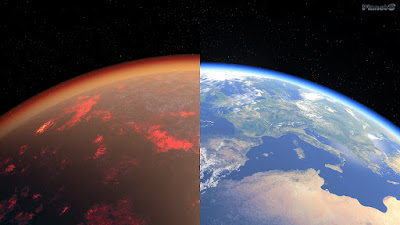
Scientists studying Earth’s early atmosphere have found that it was very similar to the atmosphere found on Venus today. 
Credit: Tobias Stierli/NCCR PlanetS


Research partly conducted at the Advanced Photon Source helped scientists discover the composition of Earth's first atmosphere. What they found raises questions about the origin of life on Earth.

A long time ago, as our solar system was forming into the planets we know today, Earth was essentially a giant ball of molten lava. Approximately 4.5 billion years ago, scientists believe that Earth collided with a planet the size of Mars. The energy from this catastrophic collision blew Earth's existing atmosphere into space, created our Moon, and caused the entire planet to melt.

Over time, this worldwide magma ocean released gases such as nitrogen, hydrogen, carbon and oxygen, creating a new atmosphere, the oldest version of the one we have today. But what, exactly, was that early atmosphere like? And why is our atmosphere now so different from those of our cosmic neighbors? These questions have perplexed scientists for generations, but the answers have eluded us until recently.

Now an international team of scientists exploring the origins of Earth's atmosphere have found that ours was once very similar to the atmosphere found on Venus and Mars today. Their findings, recently published in the journal Science Advances, have implications that go well beyond the chemical composition of Earth's early atmosphere, as the results poke holes in a popular theory of the evolution of life itself.

It turns out clues to Earth's early atmosphere were buried in our oldest rocks. What it took to uncover them was a laser furnace, a levitating ball of lava and the Advanced Photon Source (APS), a U.S. Department of Energy (DOE) Office of Science User Facility at DOE's Argonne National Laboratory.

The research team, led by Paolo Sossi, now a senior research fellow at Eidgenössische Technische Hochschule (ETH) Zürich and the National Centre of Competence in Research (NCCR) PlanetS, set out to unlock these secrets. Although they had no way of measuring Earth's ancient atmosphere directly, they found a way to measure the exact composition of the atmosphere when Earth's oldest rocks were formed.

"Four-and-a-half billion years ago, the magma—the molten rock that now lies beneath the Earth's crust—constantly exchanged gases with the overlying atmosphere," Sossi explained. "The air and the magma influenced each other. So, you can learn about one from the other."

As magma cools and turns into rock, it locks in a record of what the atmosphere was at that time. Magma is rich in iron, and the oxidation state of iron in the rocks (essentially the chemical composition of its rust) gives scientists an indication of what the Earth's early atmosphere was like, and how much oxygen was available at the time. When there is more oxygen in the atmosphere, iron bonds with oxygen in a 2:3 ratio, and the atmosphere is rich in nitrogen and carbon dioxide. When less oxygen is available, the ratio is 1:1, and the atmosphere contains more methane and ammonia.

However, to understand the exact composition of Earth's early atmosphere, the scientists essentially needed to create a miniature version of the early Earth (and its atmosphere) in the lab. To do this, they assembled the elemental components of the Earth's early mantle (known to geologists at peridotite), heated it with a laser until it became molten lava and then levitated this ball of molten lava in a stream of gas meant to represent Earth's earliest atmosphere.

When the lava cooled, the marble-sized glass ball that remained had trapped a record of the chemical reaction between the lava and the atmosphere in the iron it contained. The technological advances that made this experiment possible only came about recently. In order to melt peridotite, you have to get it very, very hot—nearly 2000°C—and then quench it quickly to preserve the chemistry at high temperatures. The ability to do this was made possible with the development of a new laser furnace technique.

The scientists repeated the experiment a number of times using various chemical compositions of gases that could have existed in the early atmosphere, then studied the iron oxidation state in the samples, looking for ones that most closely resembled those found in Earth's mantle rocks. Comparing the iron oxidation state in natural rocks with the ones formed in the lab gave the scientists an idea of which one of their gas mixtures matched Earth's early atmosphere.

"We found that the atmosphere we calculated to have been present on Earth billions of years ago was similar in composition to what we find on Venus and Mars today," said Sossi, who knew he had the correct atmospheric composition when the iron oxidation state in their sample matched those found in ancient rocks from Earth's mantle. "When you have an atmosphere produced from magma at the right oxidation state, you get one made up of about 97 percent carbon dioxide and 3 percent nitrogen once it cools down, the same ratio found today on Venus and Mars."

For years, geologists have turned to the APS to study the composition of rocks and the oxidation state of the iron contained within them. One particular beamline at the APS managed by scientists from the University of Chicago, GeoSoilEnviroCARS (13-ID-E), has become a world leader in this type of research and analysis. When the time came for the scientists to have their samples analyzed, there was an obvious place to go.

"The APS gives us the ability to make very small beams that we can do this type of analysis with," said Matt Newville, a senior research associate and beamline scientist at the APS and an author on the paper. The beamline he works on can focus its beams to as small as 1 micron across—about 50 times smaller than the width of a human hair—giving scientists the ability to make very precise and accurate measurements of their samples.

"We do this type of analysis on rocks all the time, but these were amazingly well-created samples," said Newville. "That they were able to get these samples that were very good at simulating the effect of the early atmosphere is really incredible."

Not only do these samples provide a way to measure the composition of Earth's ancient atmosphere, but they also put some geological constraints on a popular theory of the origin of life. In the 1950s, Stanley Miller conducted a groundbreaking experiment at the University of Chicago showing that amino acids—the building blocks of life—would form in an environment with liquid water and air rich in methane and ammonia when zapped with electricity to simulate lightning. At the time, these were the conditions believed to exist on the early Earth.

However, if Earth's early atmosphere was instead rich in carbon dioxide and nitrogen as this new research indicates, it would make it more difficult for these amino acids to form.


These experiments also helped answer questions as to why Earth's current atmosphere is so different from our neighboring planets. On Earth, liquid water formed out of this magma-made atmosphere, pulling carbon dioxide out of the air and into newly forming oceans. Sossi said that because all three planets—Earth, Venus and Mars—were formed from similar materials, it was the combined effects of both the Earth's large mass and its particular distance from the Sun that enabled it to retain liquid water on its surface, which then caused a carbon dioxide drawdown. Whereas that wasn't the case on Venus because it was too hot, or on Mars because it was too cold.

Now that Sossi has figured out what type of atmosphere forms from a magma-Earth, he is setting his sights on the stars. Using a modification of this experimental technique, he hopes to find a way to measure atmospheric composition using infrared so that one day we can use satellites to study magma worlds that may actually exist in other solar systems today.


Recommend this post and follow The Life of Earth

Wednesday, 28 April 2021

TOP-CITED DATASET REVEALS THAT OF 68 GLOBAL WARMING MODELS, EARTH’S OBSERVED TEMPERATURE IS BELOW 67 OF THEM

APRIL 27, 2021 CAP ALLON

The claim by the Biden Administration that climate change has placed us in a moment of “profound crisis” ignores the fact that the energy policy changes being promoted are based upon computer model simulations which have produced average warming rates at least DOUBLE those observed in the last 40+ years.

This is according to Dr. Roy Spencer, climatologist and former NASA scientist, who also points out that just about every climate claim made by politicians, and even many vocal scientists, has been either an exaggeration or a lie. Real-world observations are in stark disagreement with the “official” climate models being promoted for the purposes of implementing expensive, economically-damaging, and poverty-worsening energy policies.

Let’s take Global Ocean Temperatures as one example–with SSTs providing our best gauge of how fast this supposed extra energy is accumulating in the climate system. The 42 years of observations since 1979 (bold black line on the chart below) shows that warming is occurring far more slowly than the models said it would: the ERSSTv5, one of the top-cited datasets, reveals that Earth’s oceans have warmed at ≈50% the rate official climate projections foretold. In fact, there has been barely any warming as of the latest datapoint, plotted on March 2021:

68x CMIP6 climate model simulations of global average sea surface temperature (relative to the 5 year average, 1979-1983), compared to observations from the ERSSTv5 dataset (aka the reality).

To put it even more clearly –so alarmists can take it in– of the 68 model simulations that have been generated over the years, 67 are ABOVE the current observations, with the majority significantly above, by over a full 1 deg. C in some cases.

The global warming hypothesis has failed, that is clear for all to see, but criminally, it isn’t science that’s propping the charade up, at least not any longer; this is a political movement, and one that after decades of relentless indoctrination now has a large percentage of western populations fooled and radically onboard.

Helpfully, Dr. Spencer has provided us with another graph that might drag a few ‘brainwashed pawns’ back from that precipice. In terms of the linear temperature trends since 1979, the image below shows that the 2 top-cited ocean temperature datasets have trends at the bottom range of climate model simulations:


Linear temperature trends, 1979-2020, for the various model and observational datasets, plus the HadSST3 observational record.


This should be a ‘head in hands’ moment for the climate modelers, but humility has never proved their strong point.

DEEP OCEAN WARMING COULD BE NATURAL

A related issue here is how much the deep oceans are warming.

The inarguable energy imbalance associated with deep-ocean warming in recent decades is only about 1 part (less than 1 Watt per sq. m) in 300 of the natural energy flows in the climate system. This is a minuscule energy imbalance. We know precisely NONE of the natural energy flows to that level of accuracy, writes Dr. Spencer, meaning global warming could be mostly/entirely natural, and we wouldn’t even know it:

“[There is a] level of faith involved in the adjustments made to climate models, which necessarily produce warming due to increasing CO2 because those models simply assume that there is no other source of warming. Seldom is the public ever informed of these glaring discrepancies between basic science and what politicians and pop-scientists tell us.”

Dr. Roy Spencer concludes: “There is no Climate Emergency.”


Recommend this post and follow 
The Life of Earth

Household aerosols now release more harmful smog chemicals than all UK vehicles

APRIL 27, 2021, by University of York

Credit: CC0 Public Domain


Aerosol products used in the home now emit more harmful volatile organic compound (VOC) air pollution than all the vehicles in the UK, new research shows.

A new study by the University of York and the National Centre for Atmospheric Science reveals that the picture is damaging globally with the world's population now using huge numbers of disposable aerosols—more than 25 billion cans per year.

This is estimated to lead to the release of more than 1.3 million tons of VOC air pollution each year, and could rise to 2.2 million tons by 2050.

The chemicals now used in compressed aerosols are predominantly volatile organic compounds (VOCs), chemicals which are also released from cars and fuels. The report says the VOCs currently being used in aerosols are less damaging than the ozone-depleting CFCs they replaced in the 1980's. However, in the 80's when key international policy decisions were made, no-one foresaw such a large rise in global consumption.

In the presence of sunlight, VOCs combine with a second pollutant, nitrogen oxides, to cause photochemical smog which is harmful to human health and damages crops and plants.

In the 1990s and 2000s by far the largest source of VOC pollution in the UK was gasoline cars and fuel, but these emissions have reduced dramatically in recent years through controls such as catalytic converters on vehicles and fuel vapor recovery at filling stations.

Researchers found that on average in high-income countries 10 cans of aerosol are used per person per year with the largest contributor being personal care products. The global amount emitted from aerosols every year is surging as lower and middle-income economies grow and people in these countries buy more.

The report authors are calling on international policymakers to reduce the use of VOCs in compressed aerosols, either by encouraging less damaging propellants like nitrogen, or advocating the use of non-aerosol versions of products. At present VOCs are used in around 93 per cent of aerosol cans.

Professor Alastair Lewis from the Department of Chemistry and a Director of the National Centre for Atmospheric Science said: "Virtually all aerosol based consumer products can be delivered in non-aerosol form, for example as dry or roll-on deodorants, bars of polish not spray. Making just small changes in what we buy could have a major impact on both outdoor and indoor air quality, and have relatively little impact on our lives.

"The widespread switching of aerosol propellant with non-VOC alternatives would lead to potentially meaningful reductions in surface ozone.

"Given the contribution of VOCs to ground-level pollution, international policy revision is required and the continued support of VOCs as a preferred replacement for halocarbons is potentially not sustainable for aerosol products longer term."

The report says there are already non-aerosol alternatives that can be easily be applied in their liquid or solid forms, for example, as roll-on deodorant, hair gel, solid furniture polish, bronzing lotion, and room fragrance.

Study authors conclude that the continued use of aerosols when non-aerosol alternatives exist is often down to the continuation of past consumer habits. And that the role played by aerosol VOC emissions in air pollution needs to be much more clearly articulated in messaging on air pollution and its management to the public.

Professor Lewis added: "Labeling of consumer products as high VOC emitting—and clearly linking this to poor indoor and outdoor air quality—may drive change away from aerosols to their alternatives, as has been seen previously with the successful labeling of paints and varnishes."

Amber Yeoman, a Ph.D. student from the Wolfson Atmospheric Chemistry Laboratories was a co-author of the study which used data from industry and regulatory bodies from around the world.

The paper, "Global emissions of VOCs from compressed aerosol products" is published in Elementa: Science of the Anthropocene.


Recommend this post and follow
 The birth of modern Man

Agriculture Prices Soar Alongside Bulkship Rates

April 26, 2021, Bloomberg, By Megan Durisin and Deirdre Hipwell, with assistance from Agnieszka de Sousa, Kim Chipman, Sybilla Gross, Eko Listiyorini, James Poole, and Shuping Niu.

Massive scoop, part of a port crane, is navigated from worker while loading bulk cargo ship with wheat at Varna port, Varna, Bulgaria, May 16, 2015. 
By Stoyan Yotov / Shutterstock

The Baltic Dry Index and bulk ship rates are soaring along with related ETFs. One reason might be a surge in global wheat, corn, and soybean prices alongside new export shortages. Bloomberg explains:

By Megan Durisin (Bloomberg) Wheat, Corn, soybeans, soybean oils: A small handful of commodities form the backbone of much of the world’s diet and they’re dramatically more expensive, flashing alarm signals for global shopping budgets.

This week, the Bloomberg Agriculture Spot Index — which tracks key farm products — surged the most in almost nine years, driven by a rally in crop futures. With global food prices already at the highest since mid-2014, this latest jump is being closely watched because staple crops are a ubiquitous influence on grocery shelves — from bread and pizza dough to meat and even soda.

Soaring raw material prices have broad repercussions for households and businesses, and threaten a world economy trying to recover from the damage of the coronavirus pandemic. They help fuel food inflation, bringing more pain for families that are already grappling with financial pressure from the loss of jobs or incomes. For central banks, a spike in prices at a time of weak growth creates an unwelcome policy choice and could limit their ability to loosen policy.

“There seems to be sort of a bullish force behind the prices internationally,” Abdolreza Abbassian, senior economist at the United Nations’ Food and Agriculture Organization, said in an interview. “The indications are that there is very little reason to believe prices would remain at these levels. It’s more likely they will rise further. Hardship is still ahead.”

Emerging markets, in some cases already under pressure from weaker currencies, are particularly vulnerable because food costs make up a larger share of their spending. For the poorest and often politically unstable countries, the surge in raw materials threatens to further stoke global hunger.

“The relentless rise in prices acts as a misery multiplier, driving millions deeper into hunger and desperation,” Chris Nikoi, the World Food Programme’s regional director for West Africa, said earlier this month. It’s “pushing a basic meal beyond the reach of millions of poor families who were already struggling to get by.”

The most recent crop spikes follow months of price gains fueled by booming import demand from China. Corn prices have doubled in the past year, while soybeans are up about 80% and wheat 30%. With China’s purchases continuing and a spate of adverse weather conditions threatening crops in Brazil and the U.S., there are few signs of respite. Analysts including those at Rabobank, Mintec, and HSBC Global Research all see a risk of even higher prices as a result, though it will vary across markets.

The impact on grocery shelves can already be seen in surging tortilla prices in Mexico, beef in Brazil and retail palm oil in Myanmar. In the U.S., it’s more expensive bacon and other meat cuts.

“Generally people see this inflation continuing,” said Tosin Jack, an analyst at Mintec, which monitors commodity prices. “The trend will continue for some time and it will translate into consumer goods.”

The threat of food inflation is making governments nervous. Russia, one of the world’s top grain exporters, has ordered a freeze on some retail food prices while taking steps to curb shipments. Bolivia has temporarily banned exports of beef to safeguard supplies at home and put a lid on prices.

Overall, global food costs have surged for 10 straight months, the longest rally in more than a decade, according to a UN gauge. The surge is stirring memories of 2008 and 2011, when spikes led to food riots in more than 30 nations across Africa, Asia and the Middle East, and contributed to political strife and uprisings in the Arab Spring.

Even in rich nations, where food is a smaller percentage of overall consumer spending, changes to some bills could be coming. In Europe, for example, the time lag between rising commodity prices and higher shelf prices is typically six months, according to OC&C Strategy Consultants. Retailers and manufacturers often use various techniques to soften the blow for consumers, including cutting the depth of promotions or reducing the size of products while keeping prices unchanged.

“Once the big commodities, like wheat, sugar, bulk oils, start rising in price for a sustained period of time manufacturers have little choice but to pass those higher costs on,” said Will Hayllar, London-based managing partner at OC&C.

And commodities aren’t the only component in driving up the price of food. Higher freight costs and other supply-chain headaches as well as packaging can all add up. Food and beverage giants are already signaling they’re watching margins. Coca-Cola Co. has flagged higher costs in plastic and aluminum, as well as coffee and high-fructose corn syrup, the key ingredient in soda. Nestle SA, the world’s biggest food company, warned it won’t be able to hedge all of its commodity costs and it’s raising prices where appropriate.

“This is a very volatile environment right now, very low visibility, lots of surprise,” Nestle Chief Executive Mark Schneider said this week on a call with analysts. “We will take pricing action.”


Recommend this post and follow 
The birth of modern Man

Tuesday, 27 April 2021

A new perspective on the genomes of archaic humans

APRIL 26, 2021, by Taylor Kubota, Stanford University

Credit: CC0 Public Domain

A genome by itself is like a recipe without a chef—full of important information, but in need of interpretation. So, even though we have sequenced genomes of our nearest extinct relatives—the Neanderthals and the Denisovans—there remain many unknowns regarding how differences in our genomes actually lead to differences in physical traits.

"When we're looking at archaic genomes, we don't have all the layers and marks that we usually have in samples from present-day individuals that help us interpret regulation in the genome, like RNA or cell structure," said David Gokhman, a postdoctoral fellow in biology at Stanford University.

"We just have the naked DNA sequence, and all we can really do is stare at it and hope one day we'd be able to understand what it means," he said.

Motivated by such hopes, a team of researchers at Stanford and the University of California, San Francisco (UCSF), have devised a new method to harvest more information from the genomes of archaic humans to potentially reveal the physical consequences of genomic differences between us and them.

Their work, published April 22 in eLife, focused on sequences related to gene expression—the process by which genes are activated or silenced, which determines when, how and where DNA's instructions are followed. Gene expression tends to be the genetic detail that determines physical differences between closely related groups.

Starting with 14,042 genetic variants unique to modern humans, the researchers found 407 that specifically contribute to differences in gene expression between modern and archaic humans. In further analysis, they determined that the differences were more likely to be associated with the vocal tract and the cerebellum, which is the part of our brain that receives sensory information and controls voluntary movement, including walking, coordination, balance and speech.

"It just seems so implausible that you could make a call like, 'I think the voice box evolved,' from the information we have," said Dmitri Petrov, the Michelle and Kevin Douglas Professor in the School of Humanities and Sciences, who is co-senior author of the paper with Gokhman and Nadav Ahituv, a professor of bioengineering at UCSF. "The predictions are almost science fiction. If five years ago, somebody told me that this would be possible, I would not have put much money on it."

The path to modern humans

With such a large number of variants to examine, the researchers relied on a technique called a "massively parallel reporter assay" to test which sequences actually affect gene regulation. Their version of this technique, which was developed by Ahituv, involves packaging the DNA sequence variant into a "reporter gene" inside a virus. That virus is then put into a cell. If that variant affects gene expression, the reporter gene produces a barcoded molecule that identifies what DNA sequence it came from. The barcode allows the researchers to scan the products of a large number of variants at once.

Essentially, the whole process imitates an abridged version of how each variant would play out in a cell in real life and reports the results.

Lana Harshman, a graduate student at UCSF and co-lead author of the paper, infected three types of cells with the team's variant packages. These cells were related to the brain, skeleton and early development—subjects that are most likely to reveal evolutionary differences between us and our most recent ancestors. Carly Weiss, a postdoctoral scholar in the Petrov lab and co-lead author of the paper, analyzed the results of these experiments.

In total, the researchers found 407 sequences that represented a change in expression in modern humans compared to our predecessors. Among that list, genes that affect the cerebellum and genes that affect the voice box, pharynx, larynx and vocal cords seem to be overrepresented.

"This would suggest some kind of rapid evolution of those organs or some kind of a path that is specific to modern humans," said Gokhman. The next step, he added, would be trying to understand more about these sequences and the roles they played in the evolution of modern humans.

Even with those unknowns, this technique by itself is a significant advance for evolutionary research, said Petrov.

"This goes beyond the sequencing of the DNA from the Neanderthal and Denisovan bones. This begins to put meaning on those differences," said Petrov. "It's an important conceptual step from just the sequence—no tissue, no cells—to biological information and will enable many future studies."


Recommend this post and follow 
The birth of modern Man