Saturday, 30 November 2019

Philosophy Question- What attributes does the modern alpha male have.

Nov 30, 2019 by Chuck

pic by CiC

In their book Alpha Male Syndrome, doctors Kate Ludeman and Eddie Erlandson identify four types of alpha males: commanders, visionaries, strategists and executors.

Commanders: Ludeman and Erlandson identify these alphas as charismatic leaders. They energize those around them with “authoritative strength and passionate motivation.”

Visionaries: These are alphas who see opportunities that others either don’t see or are unwilling to seize and who inspire those around them with their vision.

Strategists: These alphas are “brilliant thinkers.” They use their good judgment and keen analytical and problem-solving abilities to accomplish tasks others can’t.

Executors: Executors are highly motivated doers, relentless in their pursuit of accomplishing tasks. They value structure and control and keep those around them as committed as they are.

Note; none of these mention physical fitness, and only one mentions intelligence.

What characteristics in your view, makes an modern Alpha male? and what place in society do they now inhabit? 

What place should Alpha males and females have in today's society, given how socialist, the human world has become (and governments run by comitte's). 

On a scale out of 100 how would you rate yourself, on the Alpha, Beta, Chuck, scale of modern man?  (assume as I do that the terms male and female apply equally, to both)

Recommend this post and follow The birth of Modern Man
 

Packaging made from banana plants an a-peeling alternative

NOVEMBER 29, 2019, by Lachlan Gilbert, University of New South Wales

Credit: CC0 Public Domain

Biodegradable 'plastic' bags made out of banana plants sounds a bit...bananas, but a couple of UNSW researchers have found a way to do it, and it could solve two industrial waste problems in one.

Two researchers at UNSW Sydney have discovered a novel way to turn banana plantation waste into packaging material that is not only biodegradable, but also recyclable.

Associate Professor Jayashree Arcot and Professor Martina Stenzel were looking for ways to convert agricultural waste into something that could value add to the industry it came from while potentially solving problems for another.

A good contender was the banana growing industry which, according to A/Prof Arcot, produces large amounts of organic waste, with only 12% of the plant being used (the fruit) while the rest is discarded after harvest.

"What makes the banana growing business particularly wasteful compared to other fruit crops is the fact that the plant dies after each harvest," said A/Prof Arcot, UNSW School of Chemical Engineering.

"We were particularly interested in the pseudostems—basically the layered, fleshy trunk of the plant which is cut down after each harvest and mostly discarded on the field. Some of it is used for textiles, some as compost, but other than that, it's a huge waste."

A/Prof Arcot and Prof Stenzel (UNSW School of Chemistry) wondered whether the pseudostems would be valuable sources of cellulose—an important structural component of plant cell walls—that could be used in packaging, paper products, textiles and even medical applications such as wound healing and drug delivery.

Using a reliable supply of pseudostem material from banana plants grown at the Royal Botanic Garden Sydney, the duo set to work in extracting cellulose to test its suitability as a packaging alternative.

"The pseudostem is 90 percent water, so the solid material ends up reducing down to about 10%," A/Prof Arcot said. "We bring the pseudostem into the lab and chop it into pieces, dry it at very low temperatures in a drying oven, and then mill it into a very fine powder."
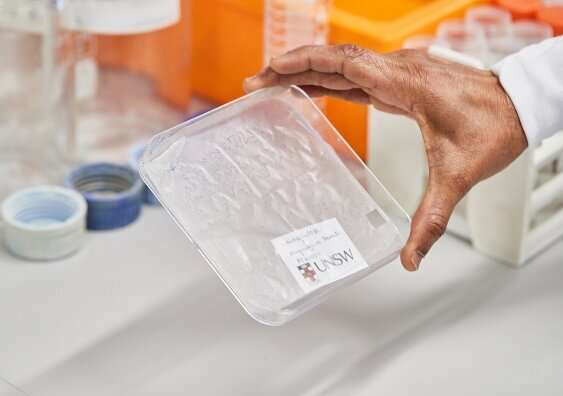
The final product has a consistency similar to baking paper. Credit: University of New South Wales
Prof Stenzel continued:

"We then take this powder and wash it with a very soft chemical treatment. This isolates what we call nano-cellulose which is a material of high value with a whole range of applications. One of those applications that interested us greatly was packaging, particularly single-use food packaging where so much ends up in landfill."

When processed, the material has a consistency similar to baking paper.

A/Prof Arcot said depending on the intended thickness, the material could be used in a number of different formats in food packaging."There are some options at this point, we could make a shopping bag, for example," she said.

"Or depending on how we pour the material and how thick we make it, we could make the trays that you see for meat and fruit. Except of course, instead of being foam, it is a material that is completely non-toxic, biodegradable and recyclable."

A/Prof Arcot said she and Prof Stenzel have confirmed in tests that the material breaks down organically after putting 'films' of the cellulose material in soil for six months. The results showed that the sheets of cellulose were well on the way to disintegrating in the soil samples.

"The material is also recyclable. One of our Ph.D. students proved that we can recycle this for three times without any change in properties," Professor Arcot said.

Tests with food have proved that it poses no contamination risks.

"We tested the material with food samples to see whether there was any leaching into the cells," Professor Stenzel said. "We didn't see any of that. I also tested it on mammalian cells, cancer cells, T-cells and it's all non-toxic to them. So if the T-cells are happy—because they're usually sensitive to anything that's toxic—then it's very benign."

Banana pseudostem is dried, then powdered, then placed in alkaline solution to extract the cellulose, which is then processed into films of varying thicknesses. Credit: University of New South Wales


Other uses of agricultural waste that the duo have looked at are in the cotton industry and rice growing industry—they have extracted cellulose from both waste cotton gathered from cotton gins and rice paddy husks.

"In theory you can get nano-cellulose from every plant, it's just that some plants are better than others in that they have higher cellulose content," Prof Stenzel said.

"What makes bananas so attractive in addition to the quality of the cellulose content is the fact that they are an annual plant," A/Prof Arcot added.

The researchers say that for the banana pseudostem to be a realistic alternative to plastic bags and food packaging, it would make sense for the banana industry to start the processing of the pseudostems into powder which they could then sell to packaging suppliers.

"If the banana industry can come on board, and they say to their farmers or growers that there's a lot of value in using those pseudostems to make into a powder which you could then sell, that's a much better option for them as well as for us," Prof Arcot said.

And at the other end of the supply chain, if packaging manufacturers updated their machines to be able to fabricate the nano-cellulose film into bags and other food packaging materials, then banana pseudostems stand a real chance of making food packaging much more sustainable.

"What we're really wanting at this stage is an industry partner who can look into how this could be upscaled and how cheap we can make it," Prof Stenzel said.

A/Prof Arcot agreed. "I think the packaging companies would be more willing to have a go at this material, if they knew the material was available readily."

Recommend this post and follow The Life of Earth

Friday, 29 November 2019


Permissive Parenting Characteristics and Effects
These parents tend to be the polar opposite of the so-called "helicopter parents." Instead of hovering over their children's every move, permissive parents are incredibly lax and rarely make or enforce any type of rules or structure. Their motto is often simply that "kids will be kids." While they are usually warm and loving, they make little or no attempt to control or discipline their kids.
Because there are few rules, expectations, and demands, children raised by permissive parents tend to struggle with self-regulation and self-control.

Early Research on Permissive Parenting

Based on her research with preschool-age children, developmental psychologist Diana Baumrind described three major parenting styles. In later years, researchers would continue to investigate the different styles of parenting and even added a fourth style. Permissive parenting is one of the original parenting styles described by Baumrind.
Permissive parenting is sometimes known as indulgent parenting. Parents who exhibit this style make relatively few demands on their children. Because these parents have low expectations for self-control and maturity, discipline is a rarity.
According to Baumrind, permissive parents "are more responsive than they are demanding. They are nontraditional and lenient, do not require mature behavior, allow considerable self-regulation, and avoid confrontation."

Characteristics of Permissive Parenting

Permissive parents:
  • Have few rules or standards of behavior
  • When there are rules, they are often very inconsistent
  • Are usually very nurturing and loving towards their kids
  • Often seem more like a friend, rather than a parent
  • May use bribery such as toys, gifts, and food as a means to get a child to behave
  • Provide little in the way of a schedule or structure
  • Emphasize their children's freedom rather than responsibility
  • Ask their children's opinions on major decisions
  • Rarely enforce any type of consequences
The Effects of Permissive Parenting
Researchers have found that the overly relaxed approach to parenting exhibited by permissive parents can lead to a number of negative outcomes. Children raised by permissive parents tend to lack self-discipline, possess poor social skills, may be self-involved and demanding, and may feel insecure due to the lack of boundaries and guidance.
Research has also suggested that kids raised by permissive parents:
  • Display low achievement in many areas. Because their parents have little to no expectations of them, these kids have nothing to strive toward. Studies have linked permissive parenting to lower academic achievement.
  • Make poor decisions. Since their parents to not set or enforce any type of rules or guidelines, these kids struggle to learn good problem-solving and decision-making skills.
  • Display more aggression and less emotional understanding. Because they do not learn to deal with their emotions effectively, particularly in situations where they do not get what they want, children with permissive parents may struggle when faced with stressful or emotionally difficult situations.
  • May be more prone to delinquency and substance use. Studies suggest that children raised by permissive parents are more likely to engage in misconduct and alcohol or substance use.
  • Unable to manage their time or habits. Because of the lack of structure and rules in the home, these kids never learn limits. This might lead to watching too much television, playing too many computer games, and eating too much. These children never learn to limit their screen time or eating habits, which can lead to unhealthy habits and obesity.
In one study, permissive parenting was linked to underage alcohol use; teens with permissive parents were three times more likely to engage in heavy drinking. Researchers also suggest that permissive parenting is linked to other risky behaviors such as drug use and other forms of misconduct.
Because permissive parenting involves a lack of demands and expectations, children raised by parents with this style tend to grow up without a strong sense of self-discipline. They may be more unruly in school due to the lack of boundaries in the home and may be less academically motivated than many of their peers.
Since these parents have few requirements for mature behavior, children may lack skills in social settings. While they may be good at interpersonal communication, they lack other important skills such as sharing.


What Can You Do About Permissive Parenting?

If you tend to be a pushover or struggle to enforce rules, consider looking for ways that you can develop some more authoritative parenting habits. This can be difficult at times, because it often means becoming stricter, enforcing rules, and being able to cope with your child being upset.
Some strategies you might consider:
  • Develop a list of basic household rules. In order for your kids to know how they are supposed to behave, they need to clearly understand what your expectations are.
  • Make sure your kids understand the penalty of breaking the rules. Guidelines are useless unless there is some sort of consequence for failing to follow them. Time-outs and losing privileges are logical consequences for breaking the household rules.
  • Follow through. This can be the greatest struggle for parents who tend to be permissive, but it is important. Try to be firm and consistent, but still loving. Help your kids understand why such rules are important by providing adequate feedback and explanations, but still make sure that consequences are in place.
  • Reward good behavior. Try to catch your children being good and allow special privileges when they display these actions.

A Word From Verywell

Permissive parenting can lead to a number of problems, so it pays to consciously try to utilize a more authoritative approach if you recognize these signs of permissiveness in your own parenting. If you tend to be more of a permissive parent, think of ways that you can help your children understand your expectations and guidelines and be consistent about your enforcement of these rules. By providing your kids with the right balance of structure and support, you can ensure that they grow up with the skills they need to succeed in life.
Bahr, S. J. & Hoffmann, J. P. (2010). Parenting style, religiosity, peers, and adolescent heavy drinking. Journal of Studies on Alcohol and Drugs. 2010;71: 539-543.
Jago R, Baranowski T, Baranowski JC, Thompson D, Greaves KA. BMI from 3– 6 y of age is predicted by TV viewing and physical activity, not diet. International  Journal of Obesity. 2005; 29(6):557–564.
Santrock, J.W. A topical approach to life-span development, 3rd Ed. New York: McGraw-Hill; 2007.
Underwood MK, Beron KJ, Rosen LH. Continuity and change in social and physical aggression from middle childhood through early adolescence. Aggressive Behavior. 2009 Sep-Oct; 35(5):357-75.
Williams LR, Degnan KA, Perez-Edgar KE, Henderson HA, Rubin KH, Pine DS, Steinberg L, Fox NA. Impact of behavioral inhibition and parenting style on internalizing and externalizing problems from early childhood through adolescence. Journal of Abnormal Child Psychology. 2009; 37(8):1063-75.

Health News - Eating banana skins can boost weight loss, improve sleep, dietician claims

Eating banana skins can boost weight loss, improve sleep, dietician claims


By Lucy Jones,  The Sun,  November 28,  2019

Banana Peels, Shutterstock

The humble banana has long been hailed a health superhero, thanks to its potassium-rich content.
But now, a top dietitian has now claimed that we should be munching on the fruit’s skin as well to really reap the health benefits.
Susie Burrell says that eating the peel can improve your sleep, enhance your skin and even boost weight loss.
“Specifically, you will increase your overall fibre content by at least ten per cent as a lot of dietary fibre can be found in the skin of the banana. You will get almost 20 percent more vitamin B6 and almost 20 percent more vitamin C and you will boost both your potassium and magnesium intake,” she said.
But don’t worry, when it comes to eating banana skin, Burrell does not recommend you just start munching on the peel once you’ve finished the inside.
Instead, she suggests putting it in a smoothie, baked goods or a curry to boost your nutritional intake.
Writing in her blog, she adds: “Rather, cooking the skin to soften it will help to break down some of the cell walls within the skin, helping to make the nutrients easy to absorb.
“Next blending the skin into recipes or smoothies is the most practical way to use them. Here you will increase the volume and nutritional content of recipes with minimal change to taste and texture of the cooking.”
Burrell also revealed that the particular banana skin you choose is important when thinking about the specific nutrients.
She says: “Specifically bananas with bright yellow skins have a higher proportion of antioxidants associated with anti-cancer effects while green skins (less ripe bananas) are particularly rich in the amino acid tryptophan which is associated with good sleep quality.
“Green banana skins are also rich in resistance starch, the special type of fibre known to benefit gut health.
“As these skins are much tougher, they are definitely best consumed after boiling to soften the skins.”
As well as their positive nutritional benefits, Burrell points out that banana skins have several other practical uses in day to day life.
For example, she says cooking meat on top of them will help to boost the moisture content of any meal and they can help make a great vinegar.
It comes after it emerged eating bananas regularly can help prevent heart attacks and strokes.
The potassium in the fruit combats the hardening and ­narrowing of arteries, scientists discovered.
The vital mineral — which spuds, broccoli and sprouts are also rich in — was found to aid blood flow to the heart and brain and reduce the risk of clots.
Its effect on the arteries emerged in US lab tests at the University of Alabama on mice.

Be sure to Recommend  The birth of modern man

A blog about life on Earthplease be sure to follow us at:
https://disqus.com/home/forum/lifeofearth/

There Are Not Enough Pigs In The World To Fill China's Pork Hole

by Tyler Durden, Fri, 11/29/2019
African swine fever has wiped out herds of pigs all over China - by some estimates more than half - and it now appears the global supply of pork might not be able to satisfy the country's demand in early 2020, reported Bloomberg.

The Ministry of Agriculture and Rural Affairs published new data on Friday that shows the number of hogs in China dropped 40% in Oct. YoY. The decline is mostly due to the African swine fever and farmers culling their herds to prevent further transmission of the dangerous disease.

The disease has spread from Africa to Europe, and currently across Asia, and are fears pork supplies around the world are dwindling and might not be able to fill China's deficit. Just this week, the Dutch government announced plans to shrink its hog industry (why? because apparently pigs smells - the government says fewer pigs means less odor nuisance and a better living environment, as well lower emissions of ammonia, in the European country with the most cows and pigs relative to land area).


A new Rabobank report projects that domestic pork supplies could hit a three-decade low and lead to higher spot pork prices early next year.


In southern China's Guangdong province, spot prices have jumped 230% since January, with much of the gains seen in late summer as the disease gained momentum and farmers were forced by the government to cull more pigs.


The jumped in spot prices wasn't just because domestic pork production collapsed, but the government has had difficulty sourcing products from abroad. It seems the world doesn't have enough pork for China.

The trade war, until recently, prevented Chinese importers from souring US pork. China has found alternative sourcing in South America, signing trade deals with Argentina and Brazil for agriculture products. Though it could take months for the pork to arrive in China, the pork deficit will likely increase in early 2020, and spot prices will move higher.

Food inflation and a decelerating economy in China are a recipe for socio-economic problems in 2020.

Recommend this post and follow The birth of modern Man

Antarctica, 'heart of the Earth' needs protection: expert

NOVEMBER 29, 2019, by Viken Kantarci


Marcelo Leppe, director of the Chilean Antarctic Institute (INACH), says the world must work to preserve the sixth continent which is like the "heart of the Earth"


It may be remote and uninhabited but Antarctica is suffering from man's activities, says the director of the Chilean Antarctic Institute, Marcelo Leppe, in an interview with AFP.

Why is Antarctica important?
Originally in school we were taught that there were only five continents around the world. Antarctica is the sixth continent, but it's a continent that you can define as the heart of Earth.

The world's main marine current is the circumpolar Antarctic current that moves from west to east around Antarctica. It appeared 13 million years ago and it has frozen a continent that was green in the past. This current has connections with the thermohaline (ocean) currents around the world.

It's like a heart because every year it changes its shape from 14 million square kilometres to more than 20 million. It expands in winter with the sea ice and retreats in summer ... You can see it beating, really beating.

And the subantarctic current is moving around the world like a circulatory system. It's probably playing a major role in the control of climate change.

So it (the current) is very important to understand and to predict, but it's also very important to preserve.

What is the impact of climate change on Antarctica?

The main impact in Antarctica is probably the cryosphere. Every year you can observe and record the melting of glaciers, the disappearance of sea ice ... and, in areas that are left without ice, the recolonisation of plants and other organisms that were not present in Antarctica before.

We have recorded that in the last 50 years, probably 15 percent of all the ice has disappeared. And in the coming years this curve will accelerate, more than originally expected in the IPCC (Intergovernmental Panel on Climate Change) predictions.

In 2100, probably an important share, more than 35 percent of the ice will have disappeared. The landscape of the Antarctic peninsula will be different and the dynamics of the sea currents will also definitely be different.

Are there any other threats? Why should we be concerned?

Antarctica is not as isolated as we think. Microplastics are starting to be a big, big issue in Antarctica. They are everywhere and ... we have detected them in all environments. We have detected them in the eggs of penguins, for example.

So what we produce in the rest of the world is reaching Antarctica and this nature that looks very untouched is actually impacted by human beings through microplastics.

When you have a continent that is regulating the weather, the climate around the world, with these teleconnections (related to each other at great distances), of course you have to pay attention.


Recommend this post and follow The life of Earth


Watching pornography rewires the brain to a more juvenile state

November 27, 2019, Rachel Anne Barr, PhD Student, Neuroscience, Université Laval

With the ubiquity and availability of devices connected to the internet, access to pornography is easier than it has ever been. (Charles/Unsplash)

Pornography has existed throughout recorded history, transforming with the introduction of each new medium. Hundreds of sexually explicit frescoes and sculptures were found in the Mount Vesuvius ruins of Pompeii.

Since the advent of the internet, porn use has skyrocketed to dizzying heights. Pornhub, the world’s largest free porn site, received over 33.5 billion site visits during 2018 alone.

Science is only just beginning to reveal the neurological repercussions of porn consumption. But it is already clear that the mental health and sex lives of its widespread audience are suffering catastrophic effects. From depression to erectile dysfunction, porn appears to be hijacking our neural wiring with dire consequences.

In my own lab, we study the neural wiring that underlies learning and memory processes. The properties of video porn make it a particularly powerful trigger for plasticity, the brain’s ability to change and adapt as a result of experience. Combined with the accessibility and anonymity of online porn consumption, we are more vulnerable than ever to its hyper-stimulating effects.

A BBC 3 programme looking at the effects of pornography addiction.
Impacts of porn consumption

In the long term, pornography seems to create sexual dysfunctions, especially the inability to achieve erection or orgasm with a real life partner. Marital quality and commitment to one’s romantic partner also appear to be compromised.

To try to explain these effects, some scientists have drawn parallels between porn consumption and substance abuse. Through evolutionary design, the brain is wired to respond to sexual stimulation with surges of dopamine. This neurotransmitter, most often associated with reward anticipation, also acts to program memories and information into the brain. This adaption means that when the body requires something, like food or sex, the brain remembers where to return to experience the same pleasure.

Instead of turning to a romantic partner for sexual gratification or fulfillment, habituated porn users instinctively reach for their phones and laptops when desire comes calling. Furthermore, unnaturally strong explosions of reward and pleasure evoke unnaturally strong degrees of habituation in the brain. Psychiatrist Norman Doidge explains:

“Pornography satisfies every one of the prerequisites for neuroplastic change. When pornographers boast that they are pushing the envelope by introducing new, harder themes, what they don’t say is that they must, because their customers are building up a tolerance to the content.”

Porn scenes, like addictive substances, are hyper-stimulating triggers that lead to unnaturally high levels of dopamine secretion. This can damage the dopamine reward system and leave it unresponsive to natural sources of pleasure. This is why users begin to experience difficulty in achieving arousal with a physical partner.

Beyond dysfunction
The desensitization of our reward circuitry sets the stage for sexual dysfunctions to develop, but the repercussions don’t end there. Studies show that changes in the transmission of dopamine can facilitate depression and anxiety. In agreement with this observation, porn consumers report greater depressive symptoms, lower quality of life and poorer mental health compared to those who don’t watch porn.

The other compelling finding in this study is that compulsive porn consumers find themselves wanting and needing more porn, even though they don’t necessarily like it. This disconnect between wanting and liking is a hallmark feature of reward circuitry dysregulation.

Following a similar line of inquiry, researchers at the Max Planck Institute in Berlin, Germany, found that higher porn use correlated with less brain activation in response to conventional pornographic imagery. This explains why users tend to graduate to more extreme and unconventional forms of porn.

Pornhub analytics reveal that conventional sex is decreasingly interesting to users and is being replaced by themes like incest and violence.

Pornography viewers are increasingly choosing more violent forms of pornography; this may be attributed to the desensitizing effect of regular consumption. (Shutterstock)

The perpetuation of sexual violence online is particularly troubling, as rates of real-life incidences may escalate as a result. Some scientists attribute this relationship to the action of mirror neurons. These brain cells are aptly named because they fire when the individual performs an action but also while observing the same action performed by someone else.

The regions of the brain that are active when someone is viewing porn are the same regions of the brain that are active while the person is actually having sex. Marco Iacoboni, a professor of psychiatry at University of California Los Angeles, speculates that these systems have the potential to spread violent behavior: “the mirror mechanism in the brain also suggests that we are automatically influenced by what we perceive, thus proposing a plausible neurobiological mechanism for contagion of violent behavior.

Though speculative, this suggested association between porn, mirror neurons and increased rates of sexual violence serves as an ominous warning. While high porn consumption may not drive viewers to harrowing extremes, it is likely to change behaviour in other ways.

Moral development
Porn use has been correlated with erosion of the prefrontal cortex — the region of the brain that houses executive functions like morality, willpower and impulse control.

To better understand the role of this structure in behaviour, it’s important to know that it remains underdeveloped during childhood. This is why children struggle to regulate their emotions and impulses. Damage to the prefrontal cortex in adulthood is termed hypofrontality, which predisposes an individual to behave compulsively and make poor decisions.

It’s somewhat paradoxical that adult entertainment may revert our brain wiring to a more juvenile state. The much greater irony is that while porn promises to satisfy and provide sexual gratification, it delivers the opposite.


Recommend this post and follow The birth of modern Man

Thursday, 28 November 2019

Laboratory-evolved bacteria switch to consuming CO2 for growth

NOVEMBER 27, 2019, by Cell Press

This diagram shows how researchers converted a common laboratory sugar eating (heterotrophic) E. coli bacterium (left) to produce all of its biomass from CO2 (autotrophic) by metabolic engineering combined with laboratory evolution. The new bacterium (center) uses the compound formate as a form of chemical energy to drive CO2 fixation by a synthetic metabolic pathway. The bacterium may provide the infrastructure for future industrial renewable production of food and green fuels (right). Credit: Gleizer et al.

Over the course of several months, researchers in Israel created Escherichia coli strains that consume CO2 for energy instead of organic compounds. This achievement in synthetic biology highlights the incredible plasticity of bacterial metabolism and could provide the framework for future carbon-neutral bioproduction. The work appears November 27th in the journal Cell.

"Our main aim was to create a convenient scientific platform that could enhance CO2 fixation, which can help address challenges related to sustainable production of food and fuels and global warming caused by CO2 emissions," says senior author Ron Milo, at systems biologist at the Weizmann Institute of Science. "Converting the carbon source of E. coli, the workhorse of biotechnology, from organic carbon into CO2 is a major step towards establishing such a platform."

The living world is divided into autotrophs that convert inorganic CO2 into biomass and heterotrophs that consume organic compounds. Autotrophic organisms dominate the biomass on Earth and supply much of our food and fuels. A better understanding of the principles of autotrophic growth and methods to enhance it is critical for the path to sustainability.

A grand challenge in synthetic biology has been to generate synthetic autotrophy within a model heterotrophic organism. Despite widespread interest in renewable energy storage and more sustainable food production, past efforts to engineer industrially relevant heterotrophic model organisms to use CO2 as the sole carbon source have failed. Previous attempts to establish autocatalytic CO2 fixation cycles in model heterotrophs always required the addition of multi-carbon organic compounds to achieve stable growth.

"From a basic scientific perspective, we wanted to see if such a major transformation in the diet of bacteria—from dependence on sugar to the synthesis of all their biomass from CO2—is possible," says first author Shmuel Gleizer, a Weizmann Institute of Science postdoctoral fellow. "Beyond testing the feasibility of such a transformation in the lab, we wanted to know how extreme an adaptation is needed in terms of the changes to the bacterial DNA blueprint."

In the Cell study, the researchers used metabolic rewiring and lab evolution to convert E. coli into autotrophs. The engineered strain harvests energy from formate, which can be produced electrochemically from renewable sources. Because formate is an organic one-carbon compound that does not serve as a carbon source for E. coli growth, it does not support heterotrophic pathways. The researchers also engineered the strain to produce non-native enzymes for carbon fixation and reduction and for harvesting energy from formate. But these changes alone were not enough to support autotrophy because E. coli's metabolism is adapted to heterotrophic growth.

To overcome this challenge, the researchers turned to adaptive laboratory evolution as a metabolic optimization tool. They inactivated central enzymes involved in heterotrophic growth, rendering the bacteria more dependent on autotrophic pathways for growth. They also grew the cells in chemostats with a limited supply of the sugar xylose—a source of organic carbon—to inhibit heterotrophic pathways. The initial supply of xylose for approximately 300 days was necessary to support enough cell proliferation to kick start evolution. The chemostat also contained plenty of formate and a 10% CO2 atmosphere.

In this environment, there is a large selective advantage for autotrophs that produce biomass from CO2 as the sole carbon source compared with heterotrophs that depend on xylose as a carbon source for growth. Using isotopic labeling, the researchers confirmed that the evolved isolated bacteria were truly autotrophic, i.e., CO2 and not xylose or any other organic compound supported cell growth.

"In order for the general approach of lab evolution to succeed, we had to find a way to couple the desired change in cell behavior to a fitness advantage," Milo says. "That was tough and required a lot of thinking and smart design."

By sequencing the genome and plasmids of the evolved autotrophic cells, the researchers discovered that as few as 11 mutations were acquired through the evolutionary process in the chemostat. One set of mutations affected genes encoding enzymes linked to the carbon fixation cycle. The second category consisted of mutations found in genes commonly observed to be mutated in previous adaptive laboratory evolution experiments, suggesting that they are not necessarily specific to autotrophic pathways. The third category consisted of mutations in genes with no known role.

"The study describes, for the first time, a successful transformation of a bacterium's mode of growth. Teaching a gut bacterium to do tricks that plants are renowned for was a real long shot," Gleizer says. "When we started the directed evolutionary process, we had no clue as to our chances of success, and there were no precedents in the literature to guide or suggest the feasibility of such an extreme transformation. In addition, seeing in the end the relatively small number of genetic changes required to make this transition was surprising."

The authors say that one major study limitation is that the consumption of formate by bacteria releases more CO2 than is consumed through carbon fixation. In addition, more research is needed before it's possible to discuss the scalability of the approach for industrial use.

In future work, the researchers will aim to supply energy through renewable electricity to address the problem of CO2 release, determine whether ambient atmospheric conditions could support autotrophy, and try to narrow down the most relevant mutations for autotrophic growth.

"This feat is a powerful proof of concept that opens up a new exciting prospect of using engineered bacteria to transform products we regard as waste into fuel, food or other compounds of interest," Milo says. "It can also serve as a platform to better understand and improve the molecular machines that are the basis of food production for humanity and thus help in the future to increase yields in agriculture."

Recommend this post and follow The birth of modern Man