Brain cholesterol can lead to Alzheimer's, study suggests
New research shows how cholesterol regulates production of Alzheimer's-associated amyloid beta, a sticky protein that builds up in the brains of Alzheimer’s sufferers.
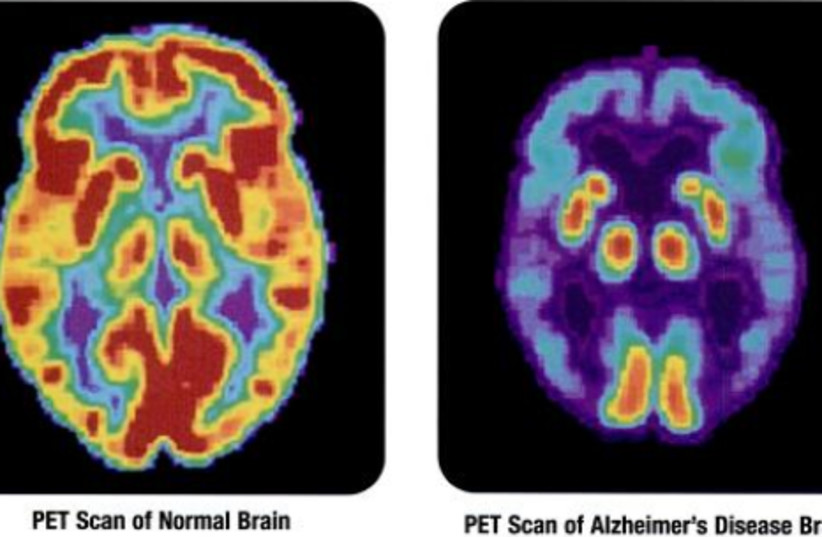 |
PET scans showing the differances between a normal
older adult's brain and the brain of an older adult afflicted with
Alzheimer's disease (photo credit: Wikimedia Commons)
Cholesterol has long been associated with clogged arteries and
heart disease but new research indicates that it can also affect the
brain.
Scientists
from the University of Virginia School of Medicine have discovered that
cholesterol manufactured in the brain appears to play a key role in the
development of Alzheimer’s disease.
The
new findings established that cholesterol produced by cells called
astrocytes are required for controlling the production of amyloid beta, a
sticky protein that builds up in the brains Alzheimer’s sufferers. The
research offers crucial insights into how and why the plaques form and
may explain why genes associated with cholesterol have been linked to an
increased likelihood of developing Alzheimer’s.
The results also provide scientists with important direction as
they try to prevent Alzheimer’s, shedding light on how to prevent the
overproduction of amyloid beta as a way to fight the disease, which
currently kills more seniors than breast cancer and prostate cancer
combined.
“This
study helps us to understand why genes linked to cholesterol are so
important to the development of Alzheimer’s disease,” said researcher
Heather Ferris of UVA Health’s Division of Endocrinology and Metabolism.
“Our
data point to the importance of focusing on the production of
cholesterol in astrocytes and the transport to neurons as a way to
reduce amyloid beta and prevent plaques from ever being formed.”
Holocaust
survivor Betty Stein, 92, (L) and Eli Boyer, 91, play ping pong at a
program for people with Alzheimer's and dementia at the Arthur Gilbert
table tennis center in Los Angeles REUTERS
Ferris noted that the findings, that have been published in the scientific journal PNAS, could be used to prevent the development of Alzheimer's.
“Once people start having memory problems from Alzheimer’s disease,
countless neurons have already died," she said. "We hope that targeting
cholesterol can prevent that death from ever occurring in the first
place."
Earlier this month, Tel Aviv University (TAU) researchers also made a groundbreaking discovery while studying amyloid beta proteins.
For the first time, a non-pharmaceutical clinical trial was proven
effective in reversing the main activators of Alzheimer’s disease,
according to TAU Prof. Shai Efrati, whose study on the use of hyperbaric
oxygen therapy to improve brain function was published in the
peer-reviewed medical journal Aging.

Please Recommend this page and follow us at:

No comments:
Post a Comment
Stick to the subject, NO religion, or Party politics